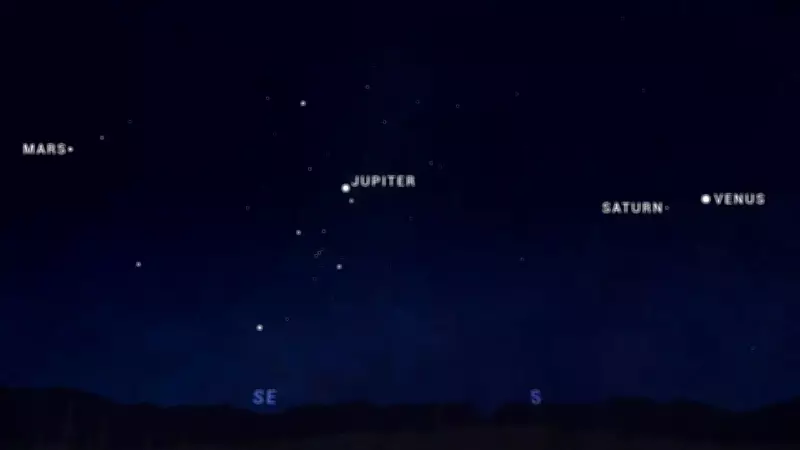
Rare Planetary Alignment to Illuminate April 2026 Dawn Sky
In a captivating celestial spectacle, the early morning sky of April 2026 is poised to showcase a rare grouping of planets, drawing the attention of skywatchers across the globe. Between April 16 and 23, Mercury, Mars, Saturn, and Neptune will appear relatively close together in the eastern sky before sunrise, with peak visibility anticipated from April 18 to 20. This event, often termed a planetary alignment or planet parade, is not a physical lineup in space but rather a visual clustering from Earth's perspective along the same orbital path known as the ecliptic.
Understanding the Celestial Phenomenon
The alignment is a striking visual effect created as these planets position themselves along the ecliptic, the same apparent path the Sun traces across the sky. In mid-April 2026, Mercury, Mars, Saturn, and Neptune will gather in a compact region of the dawn sky. Astronomers emphasize that this is not a true alignment in space, as the planets remain separated by vast cosmic distances. Instead, it is an organized appearance from our terrestrial viewpoint, offering a unique opportunity to observe solar system dynamics.
Optimal Viewing Dates and Timing
The best viewing window is notably brief, requiring precise timing. Observers in the Northern Hemisphere will have approximately 30 minutes before sunrise to catch the planets, while those in the Southern Hemisphere enjoy a slightly longer window of 60 to 90 minutes. Key dates are April 18 to 20, though the entire period from April 16 to 23 offers usable conditions. Timing is critical, as the fainter planets vanish quickly once the sky brightens with dawn's light.

Visibility of Individual Planets
Not all four planets are equally visible to the naked eye. Mercury is expected to be the brightest and most noticeable object in the group, followed by Mars, which should also be visible under good conditions. Saturn appears slightly fainter and sits lower in the sky, potentially making it harder to spot. Neptune is the outlier, being far too dim for unaided vision in dawn light; telescopes are necessary, and even then, it poses challenges due to brightening skies. Experts note that most casual observers will realistically see only two or three planets at best.
Global Visibility and Regional Differences
Visibility varies significantly by region. In much of the Northern Hemisphere, the planets hover very close to the eastern horizon, with a shallow ecliptic angle in April mornings keeping them low. Light pollution and atmospheric haze can further obscure views, with observers in northern Europe or the northern United States potentially struggling to see beyond Mercury or Mars. Saturn may appear only briefly, and Neptune is generally not a viable target.
Conditions improve markedly in the Southern Hemisphere, where the planetary group rises higher above the horizon before sunrise, providing a darker background sky. This enhances contrast, making Mercury, Mars, and Saturn easier to identify. Australia, South Africa, and parts of South America are expected to have the most stable viewing conditions, though Neptune remains faint even here.
Viewing Prospects from India
India occupies a relatively favorable position for observing the April 2026 planetary alignment, especially in its central and southern regions. The planets will appear low in the eastern sky before sunrise, but the viewing angle is better than in many higher northern latitudes, improving chances of spotting the grouping. The optimal time to look is 30 to 45 minutes before local sunrise, facing the eastern horizon with a clear, open view. Southern parts of India are likely to offer better visibility with slightly longer and clearer observation windows, while northern regions may face challenges due to shorter viewing periods and lower planetary altitudes.

Daily Evolution of the Alignment
The planetary lineup undergoes dynamic changes day by day. On April 13, Mars passes close to Neptune. By April 16, Mercury joins the grouping, and around April 17, all four planets appear tightly packed. April 18 is considered the main reference date, when the grouping is at its most recognisable. Subsequently, on April 19, Mars approaches Saturn, and by April 20, Mercury, Mars, and Saturn form a more linear arrangement in the sky.
What Skywatchers Can Expect
Reports from similar alignments suggest that most viewers will notice a compact line of bright points low in the east, with some catching only brief glimpses between obstructions like trees or buildings. Nevertheless, such events are invaluable for understanding how the solar system appears from Earth, as the clustering along the ecliptic becomes visually clear even without instruments. The April 2026 planetary alignment is a short-lived pre-dawn event best seen around mid-April, with visibility heavily dependent on location and local conditions.
In summary, this celestial event offers a fleeting yet fascinating glimpse into orbital geometry, with Southern Hemisphere observers likely enjoying the clearest views. While not a physical formation, it serves as a reminder of the intricate dance of planets in our solar system.