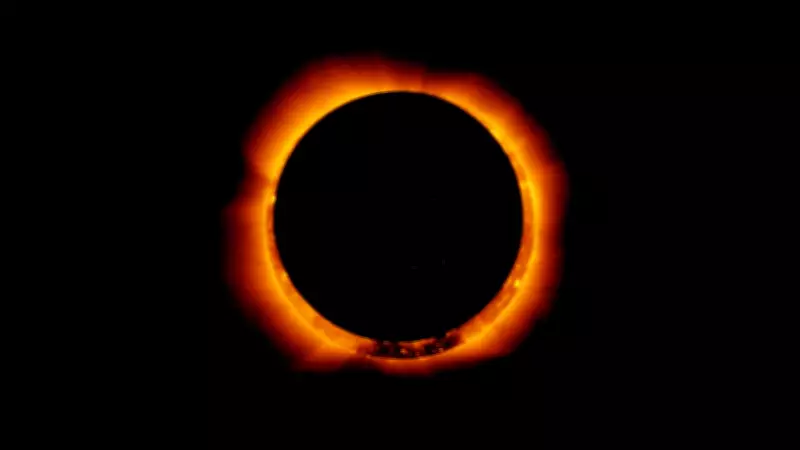
Annular Solar Eclipse on February 17, 2026: Will India Witness the 'Ring of Fire'?
The first major celestial spectacle of 2026 is set to captivate skywatchers with an annular solar eclipse, famously known as the 'ring of fire', scheduled for Tuesday, February 17. This astronomical event occurs when the Moon passes directly in front of the Sun, but due to its orbital position, it does not completely obscure the solar disk. Instead, a brilliant, fiery ring emerges around the Moon's dark silhouette, creating a stunning visual phenomenon that has fascinated humans for centuries.
Exact Timing and Global Visibility of the Eclipse
The annular solar eclipse will commence at 07:01 UTC, which translates to 12:31 PM India Standard Time (IST). Primarily, the full 'ring of fire' effect will be visible from the remote and icy continent of Antarctica, home to several scientific research stations that may offer unique viewing opportunities. Partial phases of the eclipse are expected to be observable after sunrise in specific regions of Argentina and South Africa, providing a glimpse of the celestial alignment for residents in those areas.
Unfortunately, for the vast majority of the world, including India, this annular solar eclipse will not be visible. Sky enthusiasts in India and other non-visible regions will miss out on the direct spectacle, though they can follow live streams and updates from scientific organizations. The next annular solar eclipse is projected for February 2027, with visibility spanning across Chile, Argentina, Uruguay, Brazil, Cote d'Ivoire, Ghana, Togo, Benin, and Nigeria, offering a broader audience the chance to experience this rare event.

Understanding an Annular Solar Eclipse
An annular solar eclipse is distinct from a total solar eclipse, which temporarily plunges parts of Earth into midday darkness. During an annular eclipse, the Moon is near its apogee—the farthest point from Earth in its orbit—making it appear slightly smaller than the Sun. This alignment results in the Moon blocking approximately 96% of the Sun's central disk, leaving a luminous ring that can last up to 2 minutes and 20 seconds, as noted in reports by Forbes. The term 'annular' derives from the Latin word for ring, aptly describing the circular glow that defines this event.
It is crucial to emphasize that viewing an annular solar eclipse with the naked eye is extremely dangerous and can cause permanent eye damage. The only safe method to observe this phenomenon is through specially designed eclipse glasses that filter harmful solar radiation. Skywatchers should avoid using regular sunglasses, cameras, or telescopes without proper solar filters, as these do not provide adequate protection.
Future Eclipses and Celestial Patterns
Eclipses often occur in pairs due to the alignment of the Sun, Earth, and Moon. Following the annular solar eclipse on February 17, 2026, a total lunar eclipse is set to unfold two weeks later, with visibility expected across North America, including the United States. Looking further ahead, another annular solar eclipse in 2028 will be visible from the Galápagos Islands, mainland Ecuador, Peru, Brazil, Suriname, French Guiana, Morocco, and Spain. By January 2030, an annular eclipse might be viewed from Algeria, Tunisia, Libya, Greece, Turkey, Russia, Kazakhstan, China, and Japan, highlighting the global nature of these astronomical events.
As we anticipate these future spectacles, the 2026 annular solar eclipse serves as a reminder of the wonders of our solar system and the importance of safe observation practices. While India may not witness the 'ring of fire' this time, staying informed about celestial timings and safety measures ensures that enthusiasts can fully appreciate these rare moments when they do become visible.