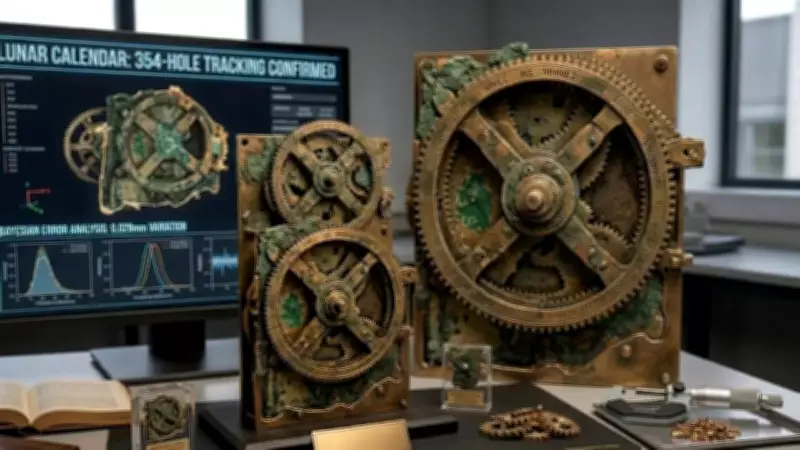
Ancient Greek Computer Mystery Finally Unraveled After 2,000 Years
For over a century, the Antikythera mechanism has captivated historians and scientists as the world's first known analogue computer. Discovered in 1901 within a Roman shipwreck off the coast of Greece, this corroded bronze artifact has long been shrouded in mystery regarding its precise internal configuration and purpose.
Breakthrough Through Experimental Archaeology
Now, a groundbreaking study from University of Glasgow researchers has finally cracked the code, thanks to an unlikely collaboration with YouTuber Chris Budiselic, creator of the 'Clickspring' channel. Budiselic's years-long project to build a historically accurate replica of the mechanism provided crucial physical data that traditional observational methods had failed to yield for more than 100 years.
This applied experimental archaeology gave scientists Graham Woan and Joseph Bayley the baseline measurements needed to apply modern statistical models to the ancient fragments. Their research represents one of the first major applications of this innovative methodological approach to archaeological artifacts.

Bayesian Statistics Reveals Lunar Calendar Design
The Glasgow team employed Bayesian statistical analysis—a method originally developed to detect gravitational waves in space by filtering out background noise—to examine the mechanism's calendar ring. Their findings, published in The Horological Journal, determined that the ring contained either 354 or 355 precisely arranged holes.
This configuration confirms the device was calibrated to track the Greek lunar calendar of 354 days, with provisions for an intercalary day, rather than the solar 365-day calendar previously speculated by some researchers. The holes were arranged with remarkable precision, featuring a radius of approximately 77.1 millimeters with radial variation of only 0.028 millimeters.
Advanced Ancient Greek Technology Revealed
This extraordinary precision indicates that ancient Greek craftsmen possessed sophisticated dividing machinery or geometric techniques far more advanced than previously believed. The mechanism, created approximately 60-70 BC, functioned as a celestial calculator capable of predicting solar eclipses and tracking the epicyclic motions of the five known planets through meticulously calibrated gear tooth geometry.
The research demonstrates that mechanical computing technology was significantly more developed 2,000 years ago than modern scholars had imagined. These findings provide a stunning glimpse into the technological prowess of ancient Greek civilization, revealing they were centuries ahead of their time in precision engineering and astronomical computation.
Cross-Disciplinary Collaboration Yields Historic Insights
This successful decoding of the Antikythera mechanism represents a triumph of cross-disciplinary research, combining:
- Experimental archaeology through replica construction
- Modern statistical analysis techniques
- Traditional archaeological study of ancient artifacts
- Horological expertise in timekeeping mechanisms
The collaboration between academic researchers and a dedicated hobbyist YouTuber highlights how diverse approaches can converge to solve historical mysteries that have persisted for millennia. The Antikythera mechanism continues to challenge our understanding of ancient technological capabilities, serving as a powerful reminder that human ingenuity has manifested in sophisticated forms throughout history.