10 Scientific Breakthroughs That Completely Transformed Warfare Forever
The history of warfare is often portrayed as a tale of brilliant generals and strategic masterminds. However, beneath the surface of these narratives lies a powerful truth: science has consistently served as the ultimate force multiplier, capable of rendering even the most successful military tactics obsolete overnight. Through a series of ten monumental advancements, the very fabric of conflict has been rewoven, shifting from the alchemical mysteries of ancient weaponry to the satellite-guided precision of the modern era.
The Accidental Alchemy: Gunpowder
Gunpowder emerged not from a battlefield laboratory, but from the accidental experiments of Chinese alchemists exploring Taoist principles. This discovery catalyzed a seismic shift in warfare, transitioning the foundation from mechanical systems like bows and catapults to chemical propulsion. Its introduction to Europe revolutionized military dynamics, rendering once-impregnable castles and the plate armor of knights virtually obsolete. Consequently, power consolidated into the hands of states that could afford the new era of cannons and artillery, reshaping political landscapes forever.
Greek Fire: The Byzantine Empire's Naval Secret
In the seventh century, the Byzantine Empire developed Greek Fire, an advanced form of chemical warfare likely composed of petroleum and other compounds that could burn even on water. This terrifying invention provided a decisive naval advantage, enabling the empire to repel massive Arab sieges of Constantinople and maintain its dominance over the Mediterranean for centuries. It stands as an early testament to how scientific innovation could dictate the fate of empires.

The Bronze Age Revolution in Weaponry
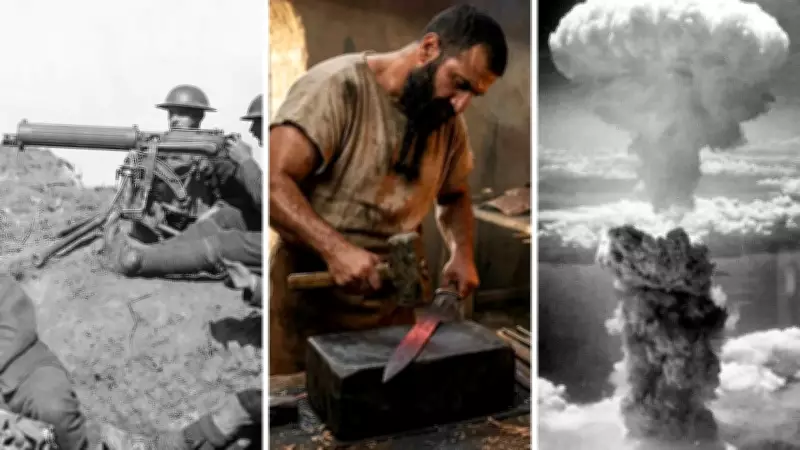
The transition from the Stone Age to the Bronze Age marked a fundamental leap in military capability. Weapons forged from bronze—a blend of copper and tin—were significantly stronger, more durable, and easier to sharpen than their stone counterparts. Advances in metallurgy facilitated the creation of sophisticated swords and armor, which in turn spurred the development of organized, professional infantry units in ancient civilizations like Mesopotamia and Egypt, laying the groundwork for structured armies.
The Printing Press: Standardizing Military Command
Johannes Gutenberg's printing press revolutionized not just literature, but military operations. By enabling the mass production of standardized maps, drill manuals, and tactical doctrines, it allowed armies with multiple division commanders to function under a unified command structure. This standardization was a cornerstone of the Military Revolution, ensuring coordinated strategies across vast theaters of war.
Satellites and GPS: The Dawn of Precision Warfare
The Global Positioning System (GPS), initially designed for military use, leverages a network of satellites and atomic clocks to deliver unparalleled location accuracy. This technology has transformed modern combat, enabling precision-guided munitions for surgical strikes with minimal collateral damage and providing ground troops with superior situational awareness, fundamentally altering engagement protocols.
The Atomic Bomb: Ushering in the Age of Total War
The Manhattan Project applied theoretical nuclear physics to harness fission, creating a weapon of unimaginable destruction. The bombings of Hiroshima and Nagasaki not only demonstrated this catastrophic power but also introduced the concept of 'Total War.' Military doctrine pivoted dramatically from active combat to strategies centered on nuclear deterrence and Mutually Assured Destruction, redefining global security paradigms.
Radar Technology: Seeing Through the Fog of War
Radar, or radio detection and ranging, uses electromagnetic energy to provide visibility in conditions like darkness or storms where it would otherwise be impossible. During World War II, Britain's Chain Home radar network allowed the Royal Air Force to detect incoming German bombers early, conserving scarce resources and drastically reshaping air defense strategies, proving that information superiority could be as critical as firepower.

Chemical Warfare in World War I: The Periodic Table as a Weapon
World War I saw the industrial-scale deployment of chlorine, phosgene, and mustard gas, marking the first use of the periodic table as a tool for mass destruction. Beyond the horrific casualties, chemical weapons inflicted profound psychological terror, spurring rapid innovations in protective gear like gas masks. Their introduction had a lasting impact on warfare, emphasizing the need for scientific countermeasures and altering post-war military conduct.
The Machine Gun: Cementing the Stalemate of Trench Warfare
Hiram Maxim's recoil-operated machine gun represented another transformative leap. By enabling sustained, rapid fire, it created deadly zones that favored defensive positions, perpetuating the grueling stalemate of trench warfare in World War I. This innovation also signaled the decline of cavalry as a viable offensive force, highlighting how a single weapon could redefine battlefield dynamics.
Rifled Barrels: Extending the Range of Engagement
The development of rifled barrels, which spin projectiles for greater accuracy and range, revolutionized military tactics in the 19th century. Soldiers transitioned from close-quarter bayonet charges to engaging enemies from hundreds of feet away, emphasizing marksmanship and long-range strategy over brute force, and setting the stage for modern infantry combat.
These ten breakthroughs illustrate a relentless pattern: scientific innovation doesn't just enhance warfare—it rewrites its very rules, forcing militaries and societies to adapt or face obsolescence. As technology continues to advance, from artificial intelligence to cyber capabilities, the next chapter in this evolution is already being written, promising further transformations in the art and science of conflict.