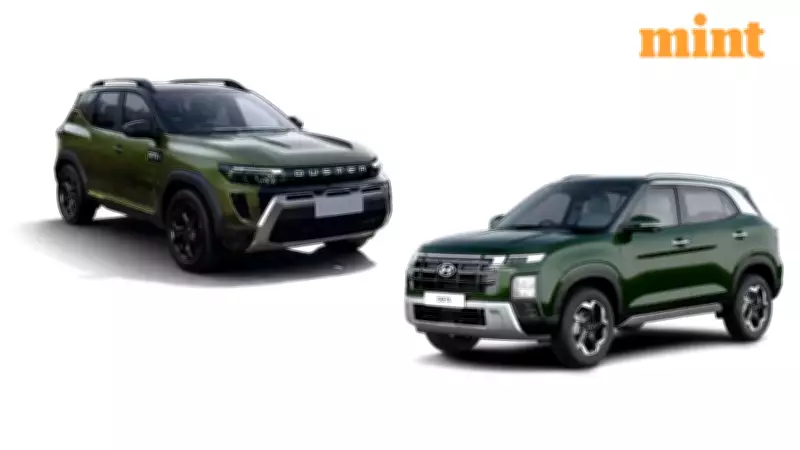
Renault Duster Returns to Challenge Hyundai Creta in India's Compact SUV Segment
The Indian compact SUV market is witnessing a significant revival with the return of a beloved nameplate. The 2026 Renault Duster, introduced just days ago, marks the comeback of one of the most popular models in India's passenger vehicle history after a four-year hiatus. This new generation SUV is poised to become a major player in the competitive segment upon its official launch in March 2026.
A Tough Battle Ahead Against the Segment Leader
However, the Duster faces an uphill battle as it prepares to lock horns with the undisputed champion of the segment. The Hyundai Creta is not only India's bestselling SUV but also outperforms numerous models across other vehicle categories in terms of sales volume. The upcoming showdown between these two rivals promises to reshape market dynamics in the coming months.
2026 Renault Duster vs Hyundai Creta: Dimension Comparison
When it comes to physical dimensions, the new Renault Duster demonstrates clear advantages over its Hyundai rival:

- Length: 4,346 mm (Duster) vs 4,330 mm (Creta) – Duster is 16 mm longer
- Width: 1,815 mm (Duster) vs 1,790 mm (Creta) – Duster is 25 mm wider
- Height: 1,703 mm (Duster) vs 1,635 mm (Creta with roof rails) – Duster is 68 mm taller
- Wheelbase: 2,657 mm (Duster) vs 2,610 mm (Creta) – Duster has 47 mm extra wheelbase
- Boot Space: 518 litres (Duster) vs 433 litres (Creta) – Duster offers 85 litres additional storage
The comprehensive dimensional analysis reveals that the 2026 Renault Duster surpasses the Hyundai Creta in every measurable aspect, providing more interior space and cargo capacity for Indian consumers.
2026 Renault Duster vs Hyundai Creta: Powertrain and Specifications
The engine options present distinct approaches from both manufacturers:
Renault Duster Powertrain Options
- 1.0-litre turbo-petrol engine: 98 bhp power, 160 Nm torque, 6-speed manual transmission
- 1.3-litre turbo-petrol with mild-hybrid technology: 160 bhp power, 280 Nm torque, 6-speed manual or 6-speed DCT
- 1.8-litre naturally aspirated petrol with strong hybrid technology: Power and torque figures to be announced, 8-speed DHT transmission
All Duster variants feature front-wheel drive configuration.
Hyundai Creta Powertrain Options
- 1.5-litre naturally aspirated petrol: 113 bhp power, 144 Nm torque, 6-speed manual or CVT
- 1.5-litre turbo-petrol: 158 bhp power, 253 Nm torque, 7-speed DCT
- 1.5-litre diesel: 114 bhp power, 250 Nm torque, 6-speed manual or 6-speed automatic
Like the Duster, all Creta variants are front-wheel drive.
Key Differentiators in Engine Technology
The Renault Duster distinguishes itself with hybrid technology offerings, including both mild-hybrid and strong-hybrid variants, reflecting the industry's shift toward electrification. Notably, the Duster lineup does not include a diesel engine option, which remains available in the Hyundai Creta for consumers who prefer traditional diesel powertrains.
The Hyundai Creta maintains a more conventional approach with its engine lineup while offering the versatility of petrol, turbo-petrol, and diesel options. This strategic difference in powertrain philosophy will likely influence consumer choices based on fuel preference and environmental considerations.
As the March 2026 launch approaches, automotive enthusiasts and potential buyers are closely monitoring how these technical specifications will translate into real-world performance, fuel efficiency, and driving experience in Indian conditions.