

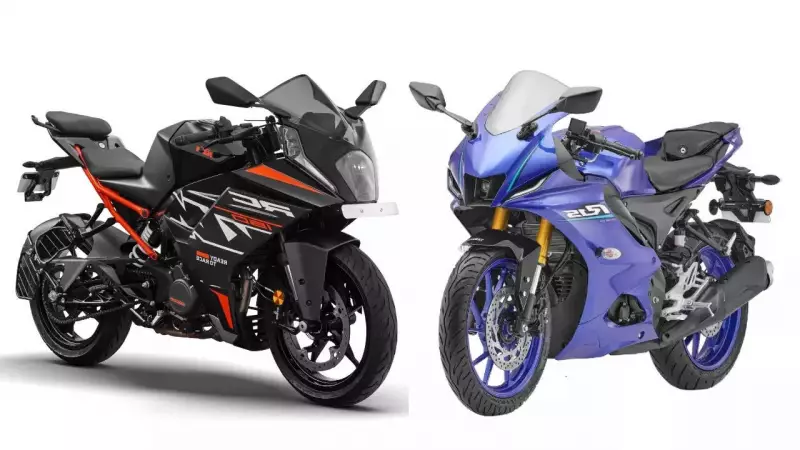
The battle for supremacy in India's entry-level fully-faired motorcycle segment has just intensified. Austrian performance brand KTM has officially launched the new RC 160, a machine designed to go head-to-head with the segment's long-reigning champion, the Yamaha R15. This move sets the stage for an epic showdown between two of the most popular sports bike brands in the country.
Engine and Performance: Power Figures Compared
At the heart of this rivalry lies a classic displacement duel. The Yamaha R15M is powered by a refined 155 cc, liquid-cooled, single-cylinder engine. This 4-stroke, SOHC, 4-valve unit is known for its smooth power delivery, producing 18.4 horsepower and 14.2 Nm of torque. It comes mated to a precise 6-speed gearbox.
KTM has opted for a slightly larger engine to make its mark. The RC 160 employs a 164.2cc, liquid-cooled, single-cylinder SOHC motor. This gives it a marginal edge on paper, with an output of 19 horsepower and 15.5 Nm of torque. The KTM also features a 6-speed transmission but sweetens the deal with an assist and slipper clutch as standard, which aids in smoother downshifts and reduces clutch lever effort.

Hardware and Chassis: A Question of Setup
The differences extend beneath the skin to the bikes' core architecture. The KTM RC 160 is built around a lightweight trellis frame, a hallmark of the brand's focus on agility. Its suspension setup consists of a 37 mm USD (Upside Down) front fork and a rear monoshock. For stopping power, it relies on a sizable 320 mm front disc and a 230 mm rear disc, with the safety of dual-channel ABS. It rolls on 17-inch alloy wheels shod with tubeless tyres and carries its fuel in a 13.75-litre tank.
The Yamaha R15M utilizes a diamond-type frame, known for its balanced rigidity. It matches the KTM with a 37 mm inverted front fork and a linked-type monoshock at the rear. Its braking components, however, are slightly smaller, featuring a 282 mm front disc and a 220 mm rear disc, though it also comes with dual-channel ABS as standard equipment. It too uses 17-inch alloy wheels.
Features and Technology: Digital Dash Duel
This is where the philosophies of the two manufacturers diverge noticeably. The KTM RC 160 offers a modern yet straightforward package. It includes full LED lighting, electronic fuel injection, and a CAN-enabled electronic architecture. Select variants also offer navigation support. Its instrument cluster is a functional LCD unit, which provides all essential data clearly.
Yamaha fights back with a more technology-rich cockpit. The R15M boasts a vibrant, full-colour TFT instrument cluster. This screen enables advanced features like Bluetooth connectivity, which provides call and SMS alerts. More crucially, the Yamaha packs performance-oriented tech such as traction control and selectable Street and Track riding modes. A quick shifter (for clutchless upshifts) is also part of the package, appealing to the enthusiast rider.
The final battleground is price, and here the competition is incredibly tight. The KTM RC 160 is priced at Rs 1.85 lakh (ex-showroom). The Yamaha R15M starts at a slightly lower Rs 1.81 lakh (ex-showroom), making the decision for buyers even more challenging.
In summary, the KTM RC 160 enters the fray with a slight power advantage and a chassis focused on raw agility. The Yamaha R15M counters with a more comprehensive electronics suite and a proven track record. The choice now boils down to whether a rider prioritizes pure mechanical specs or a more tech-aided, feature-rich riding experience.






