

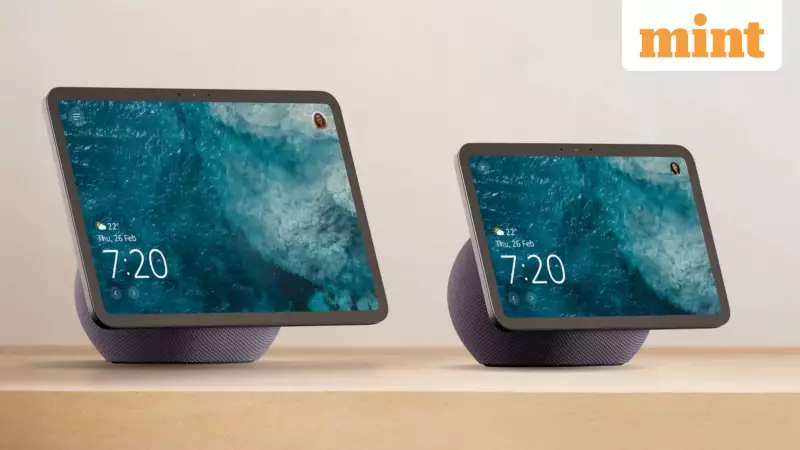
Echo Show 11 Review: Amazon's Smart Display Aims to Be Your Home's Central Hub
Let's tackle the fundamental question upfront: why invest in a smart display when smartphones already serve as powerful pocket-sized computers? It's a valid point, yet many of us still find ourselves fumbling with phones in messy kitchens, squinting at recipes, or yelling reminders across rooms as if stuck in a past era. This is precisely the gap that Amazon's new Echo Show 11, priced at ₹26,999, seeks to bridge. It offers a screen that remains accessible without the need to pick up, unlock, or keep awake while you're occupied with tasks. Simply put, it stays on standby—always listening, occasionally judging—ready to display weather updates, recipes, calendars, or song lyrics you might have forgotten. But does it present a convincing argument for installing a fixed smart display in your home?
Screen-Time and Design Evolution
It's important to note that this isn't Amazon's first Alexa-powered device with a screen; Echo Shows have been available since 2017. The previous model, Echo Show 10, even featured a motorized stand that rotated the screen toward you. The Echo Show 11, however, ditches the cylindrical speaker base in favor of an 11-inch full HD display paired with a compact, pill-shaped mesh fabric-covered base, similar to the Echo Show 8 with its 8.7-inch screen.
Both models come in Glacier and Graphite color variants, where slim screens appear to float above the base, lending a sleek, modern aesthetic while allowing speakers to project sound forward. In testing, the Show 11's screen proves to be a significant upgrade in terms of resolution, detail, brightness, and wider viewing angles. However, the new design has a drawback: the fixed screen angle offers no adjustability, so careful consideration is needed when choosing a placement spot on tables or countertops.

Setup and Performance
Once plugged in, the Echo Show 11 sets up swiftly via the Alexa app, especially if you have prior Echo devices on your Wi-Fi network. Control is possible through voice commands or the expansive touchscreen, with volume and mute buttons located on the right edge. Notably, the physical privacy slider covering the 13-megapixel camera above the display has been removed; while the mute button disables the camera feed, a shutter would have provided added privacy reassurance.
In practical use, the Echo Show 11 benefits from the faster AZ3 Pro chip in nearly every interaction—whether it's the touchscreen's responsiveness or its ability to recognize the Alexa wake word even amidst loud music. Alexa excels at voice recognition, accurately identifying complex Hindi and Tamil names in tests, though it sometimes struggles with query context. Occasional hiccups occur when handling multiple rapid requests or fetching local information, so performance may vary with more complex tasks. Alexa+, Amazon's next-generation, gen-AI powered assistant designed for more conversational and proactive interactions, is currently limited to the US, and its potential rollout could enhance these aspects.
Entertainment and Home Automation Capabilities
Using the Echo Show 11 for entertainment is a markedly improved experience. The two full-range speakers and 2.8-inch woofer deliver superior sound compared to earlier models, with enhanced bass and clearer vocals, making it suitable as a party speaker for small to mid-sized rooms—supporting Prime Music, Apple Music, and Spotify. Clarity and volume are particularly impressive. The display is finally large enough to enjoy TV shows and movies or view calendars and Alexa responses from a distance, though the user interface sometimes underutilizes screen space or clutters it with unnecessary cards and suggested content.
For optimal streaming, Amazon Prime Video and Netflix are recommended as they have dedicated apps; YouTube and other services are only accessible via the slightly clunky Silk web browser in mobile browser form, which is less than ideal.
What truly sets the Echo Show apart is its extensive library of Alexa "skills." Beyond controlling Alexa-compatible devices, the Echo Show 11 supports Zigbee, Matter, and Thread standards, enabling direct control of compatible smart devices like bulbs without a hub. Compatible devices and their controls are displayed on-screen and manageable via voice commands.

A new feature is Omnisense, Amazon's ambient AI sensor platform, which uses the camera and sensors to detect room presence and trigger routines—such as turning lights on or off—when someone enters or leaves. While presence-based routines work reliably once set up, the configuration process can be daunting for beginners, suggesting Amazon could simplify it for first-time home automation users.
The built-in temperature and brightness sensors are handy for unpredictable weather, like recent conditions in Bengaluru, though full utilization requires compatible devices. Additionally, the camera offers auto-tracking and framing for video calls and drop-in features to check on pets or loved ones via the app.
Verdict: Is It Worth the Investment?
So, should you spend ₹26,999 on the Echo Show 11? Its design is mature and refined, with notable improvements in screen and audio quality. However, it truly shines as a central hub for smart homes, making it more appealing for those already invested in Alexa-compatible devices. Unlike more compact previous Echo Shows, this isn't suited as a bedside assistant. Instead, it's best placed in a central location—functioning as a smart assistant, mini-TV, and life observer, especially when you repeatedly ask for timers. In essence, the Echo Show 11 carves out its niche for users seeking a dedicated, always-available smart display to streamline daily tasks and enhance home automation.





