ASUS Republic of Gamers (ROG) chose its 20th-anniversary celebration at CES 2026 to unleash its most revolutionary hardware portfolio to date. The virtual "Dare to Innovate" event was headlined by the launch of the Zephyrus Duo, acclaimed as the world's first gaming laptop with dual 16-inch displays. The showcase also highlighted a strategic partnership with Kojima Productions, introduced next-generation AI-capable Zephyrus laptops, and debuted the G1000 desktop featuring an industry-first holographic cooling system.
Next-Gen Laptops: AI Power and Dual-Screen Dominance
The spotlight firmly fell on the new Zephyrus series, engineered for smarter performance. The Zephyrus G14 and G16 are powered by Intel Core Ultra Series 3 processors, integrating a Neural Processing Unit (NPU) capable of 50 TOPS for handling local AI tasks efficiently. The G14 (GU405) can be configured with up to an NVIDIA GeForce RTX 5080 Laptop GPU, while the G16 (GU606) scales up to the top-tier RTX 5090 based on the new NVIDIA Blackwell architecture, supporting DLSS 4. ROG has significantly boosted GPU power, with the G14 reaching 130W and the G16 hitting 160W in manual mode, marking a 23% increase.
Both models boast stunning 1100-nit Nebula HDR displays with full DCI-P3 color coverage and exceptional Delta E < 1 accuracy. Cooling has been redesigned with optimized vents and liquid metal application on the CPU. The star of the show, however, is the Zephyrus Duo (GX651). This beast features dual 3K ROG Nebula HDR OLED touchscreens, each measuring 16 inches, refreshing at 120Hz with a 0.2ms response time. Driven by Intel's latest CPU and up to an RTX 5090 GPU, it operates in five distinct modes for gaming and creation, supported by an advanced vapor chamber cooling system.

Desktops, Motherboards, and Displays Redefine Limits
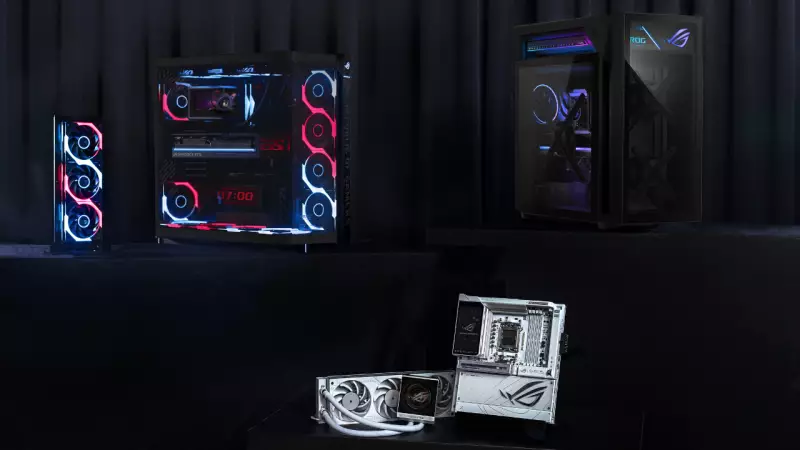
For desktop enthusiasts, ROG unveiled the groundbreaking G1000. This pre-built gaming PC introduces the world's first holographic fan system. The AniMe Holo fan projects customisable holographic visuals from a separate chamber, isolating its airflow to minimise noise and thermal interference for core components. The tower supports up to an ROG Astral GeForce RTX 5090 GPU, 128GB of DDR5 memory, and 4TB of PCIe 4.0 SSD storage.
On the motherboard front, the flagship Crosshair X870E Glacial won a CES 2026 Innovation Award. It packs 24+2+2 power stages, seven M.2 slots (including dual PCIe 5.0), and dual USB4 ports. It is loaded with AI features like AI Cache Boost and AI Overclocking for streamlined optimisation. For displays, ROG reinforced its OLED leadership with the Swift OLED PG27UCWM. This 26.5-inch monitor uses Tandem RGB Stripe OLED tech, offering a switchable 4K@240Hz or FHD@480Hz mode, with a lightning-fast 0.03ms response time.
Strategic Collaborations: Kojima Productions and XREAL
ROG's partnership with legendary game studio Kojima Productions yielded the Flow Z13-KJP, a 2-in-1 gaming tablet designed by art director Yoji Shinkawa, inspired by the studio's Ludens mascot. It runs on an AMD Ryzen AI Max+ 395 processor with Radeon 8060S graphics. Matching peripherals like a headset, mouse, and mouse pad complete the themed collection.
In the augmented reality space, a collaboration with XREAL produced the ROG XREAL R1 Gaming Glasses. Touted as the world's first 240Hz micro-OLED FHD AR glasses, they project a virtual 171-inch screen at 4 meters with a 57° field of view, featuring electrochromic lenses that auto-adjust to lighting and spatial audio by Bose.
These announcements mark a pivotal moment for ROG, reflecting on two decades of innovation since its first Crosshair motherboard in 2006. Through its experimental ROG Lab and key partnerships, the brand continues to push gaming hardware into new creative and spatial dimensions, setting the agenda for the future of high-performance gaming.