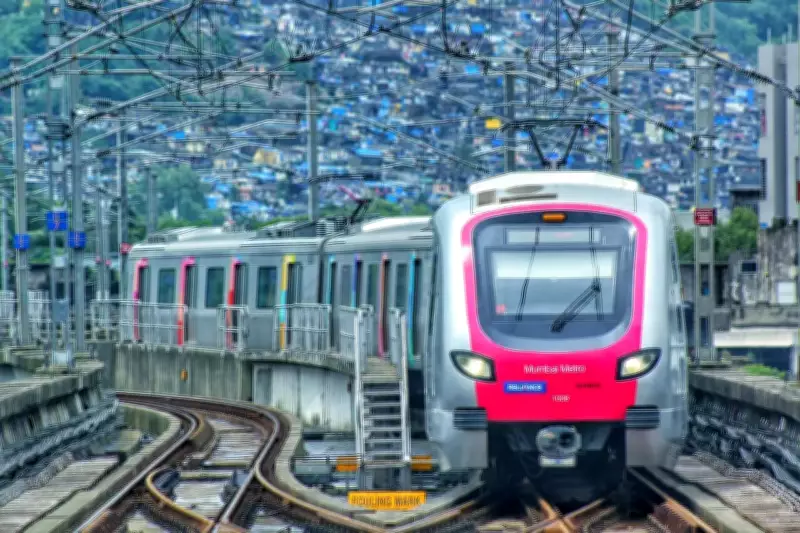
Mumbai's first Metro line, the Ghatkopar–Versova Metro 1 corridor, has demonstrated that improved connectivity leads to higher ridership. The 11-kilometer stretch has become a crucial cross-city spine as new routes integrate with it. Since Metro 7 and 2A opened in January 2023, and Metro 3 (Aqua) joined the network in October 2024, Metro 1 has added 2.76 crore additional commuters in 2023-24 and another 1.06 crore in 2024-25. With interchanges at Marol, Western Express Highway, and D N Nagar, ridership has never plateaued, doubling from 7.6 crore in 2014-15 to 15.7 crore in 2025-26.
12-Year Milestone
Metro Line 1 completes 12 years on Monday (June 8) with numbers reflecting a decisive shift in the city's commuting patterns toward rapid transit. On an average day, it carries more than five lakh commuters, higher than the daily ridership of any other Metro corridor currently operational in Mumbai.
New RuPay Card Launch
To mark the anniversary, the operator will launch a RuPay 'On-The-Go' Card in partnership with Airtel Payments Bank Ltd. The card is designed for use across Mumbai Metro Line 1, Metro Lines 2A and 7, Metro Line 3, BEST buses, and the Monorail network.

Demand for Six Coaches
Activists have demanded six coaches for years, citing overcrowding. "The train continues to run with only four coaches despite being designed for six," activist Zoru Bhathena said. "It's been packed since day one," he noted, adding that adding two coaches would raise capacity by 50% and ease crowding. While frequency is adequate, carrying capacity remains capped at 60%. With Metro 1 connecting to Metro 3, 7, and 2A, ridership will continue to rise.
Ridership Milestones
The first post-pandemic five-lakh daily ridership milestone was achieved on August 13, 2024, while the all-time high of 5.79 lakh passengers was recorded on October 15, 2025.
Speed and Predictability
For office-goers, students, and shoppers, the corridor's core appeal remains speed and predictability. The 11-km line cuts the cross-suburbs commute to roughly 21 minutes, connecting key residential and commercial nodes between Ghatkopar and Versova, providing a dependable alternative to road congestion.
Operator's Focus
Mumbai Metro One Pvt. Ltd. CEO Shyamantak Choudhury said the focus remains on "safe, reliable and world-class metro services" while innovating to improve.
Ridership Curve
The ridership curve mirrors disruption and recovery in the city. Patronage rose steadily to 13.15 crore in 2019-20 before collapsing to 1.01 crore in 2020-21 during the pandemic. The rebound began with 4.04 crore riders in 2021-22 and accelerated sharply thereafter, touching 14.39 crore in 2024-25 and reaching a record 15.68 crore in 2025-26.
Operational Output
Operational output has followed a similar trajectory. Train trips increased from 1,08,110 in 2014-15 to 1,31,200 in 2019-20, dropped to 31,811 in 2020-21, and climbed to a new high of 1,55,115 trips in 2025-26—about a 50% increase over the first year of operations. The operator's turnover has also risen from under Rs 150 crore in 2014-15 to over Rs 400 crore in 2025-26, supported by both fare and non-fare revenue.
Fares Unchanged
Even as passenger volumes have grown, fares have remained unchanged since the line opened in 2014—Rs 10, 20, 30, and 40.