New Delhi: Delhi Police has installed variable message sign (VMS) displays at 96 locations across the city to provide congestion-related alerts to commuters. The traffic police is currently integrating VMS with the soon-to-be-rolled-out Intelligent Traffic Management System (ITMS).
What is VMS?
VMS is a digital roadside display system that communicates live information to motorists, including traffic flow updates and incidents. ITMS will generate alerts in case of accidents or congestion. Once approved by the control room, messages will be displayed on VMS in the affected area, advising commuters to avoid the stretch, officers said on Saturday.
Integration with Other Systems
ITMS will also be integrated with the Safe City Project for shared camera feeds and will connect with the National Highways Authority of India’s system for alerts and enforcement. The system will share infrastructure with Safe City and ERSS-112 during emergencies to ensure a coordinated response.

Major Upgrade for Delhi's Traffic Network
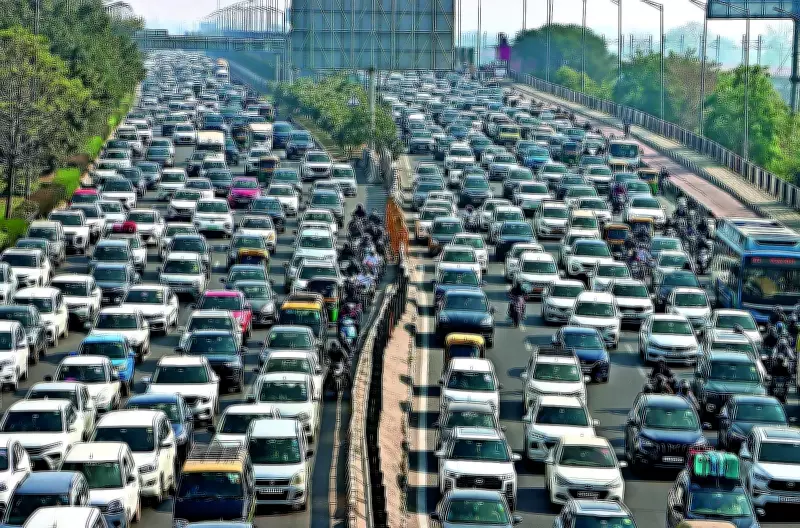
Touted as a major upgrade for Delhi’s congested traffic network, ITMS aims to improve real-time traffic monitoring. The Rs 2,101.4-crore project will be executed over two years in three phases, once approval from the central government is granted. The first phase will cover five corridors, followed by seven in the second phase and 30 in the last one. Delhi has around 1.5 crore registered vehicles, with 8.1 lakh added in 2025. Adding to the pressure, nearly 11 lakh vehicles enter and exit Delhi daily from the rest of the National Capital Region. The city’s road infrastructure includes approximately 1,800 km of arterial roads and a total network of about 16,000 km.
Enforcement Capabilities
According to officers, ITMS will enable enforcement of at least 20 categories of traffic violations, including automatic number plate recognition, wrong-way driving, and illegal parking. It will also include advanced features such as tracking stolen vehicles, identifying hit-and-run cases, detecting repeat traffic offenders, and monitoring hotlisted and overage vehicles. This will assist not only traffic police but also district police in crime detection and investigation.
Traffic Regulation and Management
For traffic regulation and management, the system will assist police in handling vehicle breakdowns, debris on roads, accident detection, monitoring VIP movements, and managing route diversions. During emergencies, it will also help ensure smooth and priority movement of ambulances and disaster response vehicles by monitoring and clearing routes.
System Architecture
The system spans multiple layers. The physical layer includes networks, controllers, sensors, and enforcement cameras such as ANPR, red-light, overspeed, mobile, and VMS. The digital layer integrates devices for real-time data capture and processing, while the application layer covers traffic analytics, enforcement, parking, congestion and signal control, incident management, video systems, and adaptive traffic control. On top, the platform offers real-time visualization, GIS mapping, simulations, third-party integration, crowdsourced data, and other features.
Special Commissioner of Police (Traffic) Neeraj Thakur said ITMS was designed to transform traffic monitoring and management through real-time, data-driven decision-making. It will help reduce congestion by quickly detecting incidents such as accidents and breakdowns, while strengthening traffic discipline through automated violation detection.
“By integrating multiple regulation and enforcement tools on a single platform, ITMS will improve inter-agency coordination, speed up emergency response for ambulances and disaster management vehicles, and ensure smoother traffic flow across Delhi’s dense road network, making urban mobility safer and more efficient,” he said.