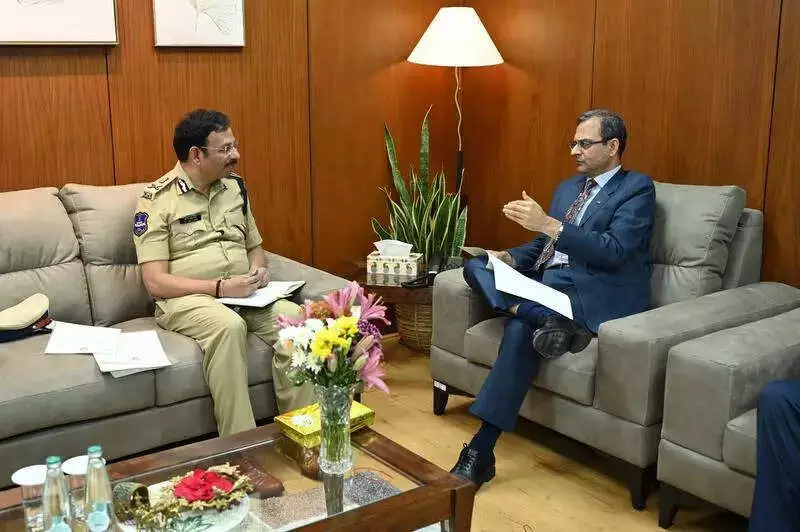
In a significant move to tackle the escalating threat of cyber-enabled financial crimes, Hyderabad's top police official made a direct appeal to the Reserve Bank of India's leadership for systemic reforms. The appeal highlighted the critical role of bank accounts opened by unsuspecting citizens in fueling a nationwide crime wave.
A Direct Appeal for a Paradigm Shift
Hyderabad Commissioner of Police, VC Sajjanar, held a crucial meeting with RBI Governor Sanjay Malhotra and Deputy Governor Swaminathan on Friday. The meeting took place at the RBI's regional office in Hyderabad. Commissioner Sajjanar presented a stark warning, stating that unchecked 'mule accounts' are the primary engine behind a surge in cybercrimes across India.
He detailed the modus operandi, explaining that fraudsters systematically recruit students and daily wage earners, paying them a paltry sum between Rs 2,000 and Rs 5,000 to open new bank accounts. These accounts are then used as conduits to swiftly siphon off stolen funds, often within minutes of a cyber-fraud being executed, making traceability extremely difficult for law enforcement.

Blueprint for a Stronger Defence
To choke this pipeline of illicit money, CP Sajjanar proposed a multi-pronged strategy to the central bank. His key recommendations included:
- A dedicated centralised database to track and flag suspicious account-opening patterns across all banks.
- The development of a real-time 'mule-hunter' analytical tool for banks to identify potential mule accounts at the onboarding stage itself.
- Implementing stricter Know Your Customer (KYC) vetting processes, especially for accounts opened by vulnerable demographic groups targeted by fraudsters.
Beyond preventive measures, the police commissioner also sought operational improvements to accelerate investigations. He requested faster access to technical evidence from banks, standardised formats for financial statements provided to police, and closer coordination with central agencies to avoid procedural delays that benefit criminals.
RBI's Response and Delegation
In response, RBI Governor Sanjay Malhotra acknowledged the concerns and assured that both the central bank and commercial banks have already undertaken several measures to reduce digital frauds. He committed to further reinforcing the security of the payment ecosystem in light of the evolving threats.
The police delegation at this high-level meeting also included Additional Commissioner of Police (Crimes) M Srinivasulu, DCP (CCS) Shweta, and DCP (Cybercrimes) Aravind Babu, underscoring the seriousness with which Hyderabad Police is approaching the cybercrime challenge.
This collaborative dialogue between top law enforcement and banking regulators marks a critical step towards building a more unified and proactive front against the sophisticated networks exploiting financial systems for cyber fraud.