

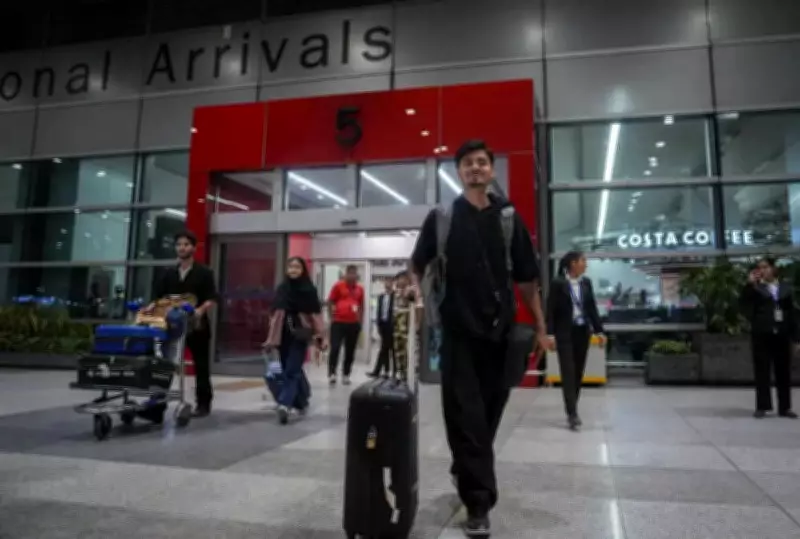
New Delhi: Just hours after US Secretary of State Marco Rubio landed in Delhi on Saturday, the capital's Indira Gandhi International Airport once again became a target of GPS spoofing. Approximately 10 to 12 aircraft approaching the airport on Saturday evening and night reported the menace, which was observed on this scale after a gap of several months. Government agencies are investigating the sudden recurrence of GPS spoofing — a cyberattack where counterfeit radio signals are transmitted to override genuine satellite signals — and notably, its timing coinciding with a VVIP visit.
Impact on Air Traffic
Air traffic control immediately increased the spacing between incoming aircraft to allow more time for guiding them safely to the airport using radar vectors. This resulted in congestion and some flight delays. Controllers explained that when spoofing occurs, they revert to pre-GPS flying methods, meaning aircraft must fly from point to point instead of taking direct routes to their destinations. This requires greater surveillance of aircraft positions.
Below 14,000 feet, aircraft headed to Delhi normally maintain a separation of 3 nautical miles. On Saturday night, this was increased to 5 nautical miles. This measure affects capacity; Delhi can normally handle 42 arrivals per hour, but the number falls to about 30 when aircraft have to be flown using radar vectors or without GPS.

Types of GPS Interference
Broadly speaking, airlines face two types of GPS issues: jamming and spoofing. Jamming is usually employed by militaries in war zones to avoid revealing the location of military assets, including aircraft. Spoofing, on the other hand, is used by troublemakers in conflict zones — from Pakistan to West Asia, Turkey, and Ukraine — to confuse pilots. Spoofing corrupts GPS signals, causing pilots to receive incorrect location information, sometimes showing them up to 2,500 kilometers away from their actual position.






