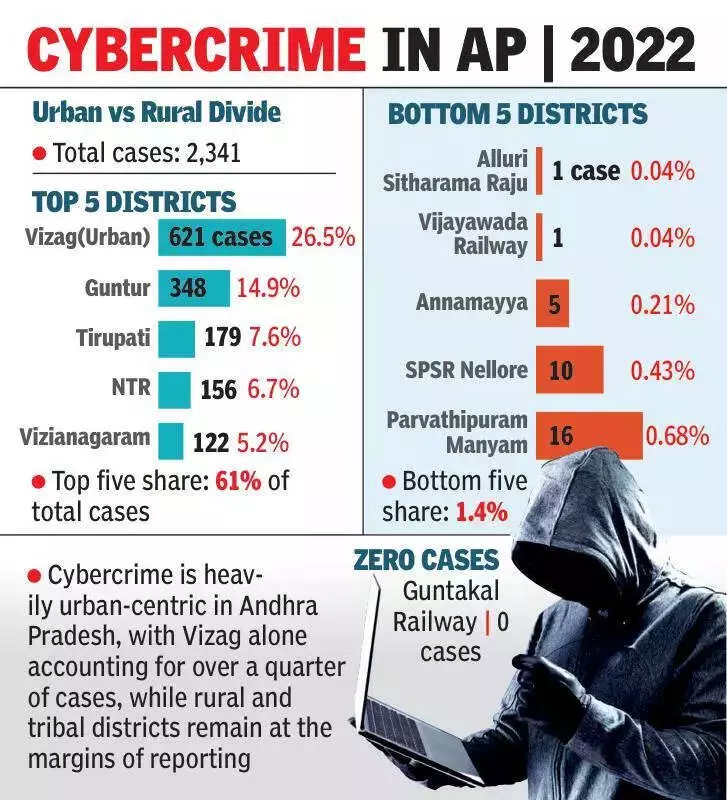
New data from the National Crime Records Bureau (NCRB) paints a stark picture of cybercrime in Andhra Pradesh, revealing a heavy and persistent concentration in major urban centres while rural and tribal districts remain largely untouched. This pattern highlights the state's growing digital divide and presents a dual challenge for law enforcement.
The Urban Cybercrime Hotspots
A detailed analysis of the past five years shows a clear and consistent trend. Undivided Visakhapatnam district topped the state's cybercrime charts every year from 2018 to 2021, with cases ranging from 427 in 2018 to 323 in 2021. Vijayawada City was a close second, hitting a peak of 240 cases in 2019. Guntur Urban witnessed a steep rise, escalating from 58 cases in 2018 to 211 in 2021.
The trend intensified after the state's district reorganisation in 2022, when overall cybercrime cases in Andhra Pradesh jumped to 2,341. Visakhapatnam (urban) alone accounted for 621 cases, the highest single district tally, firmly establishing it as the state's cyber fraud capital. Guntur reported 348 cases, and the newly formed NTR district logged 156. Other high-reporting districts included Tirupati (179) and Vizianagaram (122).

The Rural and Tribal Contrast
In sharp contrast, several districts and railway jurisdictions reported negligible or zero cybercrime during the same period. For instance, Guntakal Railway and Vijayawada Railway zones recorded no cases in most years. The disparity became even more pronounced in 2022.
Tribal and sparsely populated districts consistently reported the lowest numbers. Alluri Sitharama Raju district registered just one case in 2022, Annamayya reported five, and Parvathipuram Manyam recorded 16. This starkly underlines the gap between urban and rural Andhra Pradesh in terms of both cybercrime incidence and reporting.
Root Causes and Policy Implications
Officials explain that urban districts, with their higher internet penetration, widespread use of digital payments, active e-commerce, and dense populations, are naturally more vulnerable targets for cybercriminals. Conversely, in rural and tribal districts, where digital transactions are limited and awareness is lower, fewer cases are reported—though authorities acknowledge that significant under-reporting is a possibility.
Part of the recorded rise in cities is also attributed to improved reporting mechanisms, such as the National Cyber Crime Reporting Portal and the dedicated 1930 helpline. However, the persistent concentration of cases in urban areas indicates that cybercriminals are strategically targeting digitally active, metropolitan populations.
The data underscores a critical policy challenge: the need to strengthen cyber policing and fraud prevention in overburdened urban centres like Visakhapatnam, Guntur, and NTR district. Simultaneously, there is an urgent requirement to bridge the digital divide by improving awareness, access, and reporting mechanisms in rural and tribal regions to create a more secure cyber environment across the entire state.