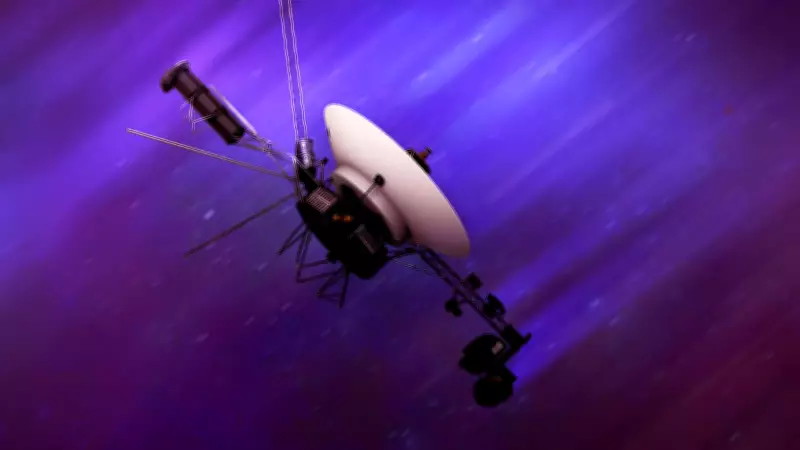
Voyager 1 Approaches Historic 24-Hour Signal Milestone in Deep Space Journey
NASA's Voyager 1 spacecraft continues its unprecedented journey through the cosmos, moving farther from Earth than any human-made object in history. Launched in 1977 as part of an ambitious planetary exploration mission, this remarkable probe has fundamentally transformed our understanding of the outer solar system and beyond.
Historic Planetary Encounters and Scientific Revelations
During its initial mission phase, Voyager 1 conducted groundbreaking flybys of Jupiter and Saturn, capturing stunning images and collecting invaluable data that revolutionized planetary science. The spacecraft's observations revealed volcanic activity on Jupiter's moon Io, intricate details of Saturn's rings, and atmospheric phenomena that had never been documented before. Remarkably, Voyager 1 exited the asteroid belt earlier than anticipated and eventually overtook its twin spacecraft, Voyager 2, as both probes ventured toward interstellar space.
Entering the Interstellar Realm
In 2012, Voyager 1 achieved a monumental milestone by crossing the heliopause boundary and entering interstellar space—the region between stars containing material from long-dead suns. This made it the first human-made object to reach this distant frontier. Voyager 2 followed suit in 2018 after taking a different trajectory that included historic encounters with Uranus and Neptune, making it the only spacecraft to study these ice giants directly.

The Growing Communication Lag
As both spacecraft continue their outward journey, communication with Earth becomes increasingly challenging due to vast distances. Currently, signals from Voyager 1 take approximately 23 hours and 32 minutes to reach our planet, meaning one-way communication requires nearly a full day. By late 2026, estimates suggest the probe will be approximately 16.1 billion miles (25.9 billion kilometers) from Earth, at which point radio signals will require a full 24 hours to complete their journey.
This approaching milestone represents more than just a measurement of distance—it serves as a profound reminder of the immense scale of space and the limitations of human technology when exploring such vast cosmic distances.
Ongoing Scientific Contributions
Despite their age and distance, both Voyager spacecraft continue to transmit valuable scientific data through NASA's Deep Space Network. Their instruments remain operational, measuring cosmic rays, plasma waves, magnetic fields, and low-energy charged particles in regions never before explored by human technology. This information provides crucial insights into the structure of our solar system's boundary and the nature of interstellar space.
Extended Mission and Legacy
Originally designed for a four-year mission to study Jupiter and Saturn, the Voyager program has been extended multiple times and now operates as the Voyager Interstellar Mission. These spacecraft have far exceeded their initial objectives, continuing to function more than 45 years after launch. Their discoveries—from active volcanoes on Io to the complex dynamics of planetary rings—have reshaped planetary science and inspired generations of scientists and space enthusiasts.
The Human Perspective on Cosmic Exploration
Voyager 1's approaching 24-hour signal milestone highlights both human achievement and cosmic perspective. The spacecraft moves through regions shaped by stellar phenomena millions of years old, carrying instruments that quietly sense an environment humans can only study indirectly. The growing communication lag demonstrates the fundamental limits imposed by the finite speed of light, while the spacecraft's steady, indifferent motion outward serves as a quiet witness to cosmic processes on timescales far beyond human experience.

Future Trajectory and Scientific Value
Both Voyager spacecraft continue their journey into uncharted territory, carrying with them the legacy of early planetary exploration. As they drift further into the interstellar medium, their instruments will eventually cease functioning when power supplies diminish, but their trajectories will carry them indefinitely through the Milky Way. The data they continue to send forms a crucial bridge to regions humans cannot physically visit, expanding our understanding of the cosmic neighborhood we inhabit.
These pioneering spacecraft represent humanity's most distant physical presence in the universe, carrying not just scientific instruments but also golden records containing sounds and images of Earth—a message to any potential future discoverers about the civilization that launched them into the cosmos.