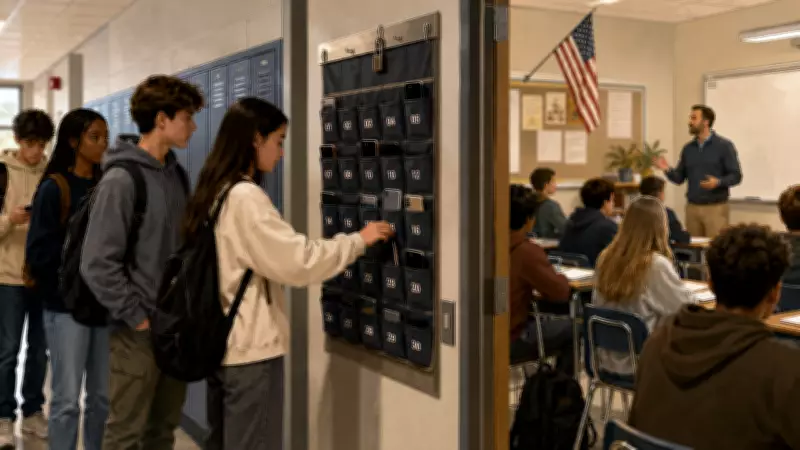
Across the world, the school smartphone is no longer being treated as a matter of teacher preference or student etiquette; it is being written into law, guidance and national school policy. Estimates suggest that in the US, at least 37 states and the District of Columbia now require districts to ban or restrict student cellphone use, though the strictness of those rules varies widely — from class-time limits to bell-to-bell curbs. England is preparing a statutory school mobile-phone ban while the Netherlands has already pushed phones out of classrooms across secondary, primary and special education. Australia also has restrictions across all public schools while South Korea’s nationwide classroom ban started from March 2026. UNESCO says 114 education systems, representing 58% of countries worldwide, now have national school-phone bans.
The proposition is disarmingly simple: Take away the phone, and schools may recover attention, discipline, face-to-face interaction, mental well-being and academic seriousness. The latest US evidence, however, refuses to be quite so obedient to the policy promise. A working paper by the National Bureau of Economic Research (NBER), titled The Effects of School Phone Bans: National Evidence from Lockable Pouches, finds that while such restrictions substantially reduce students’ phone use, they do not appear to produce broad improvements in test scores, attendance, classroom attention or perceived online bullying. The first year, in fact, comes with its own complications: a rise in disciplinary incidents and a dip in student well-being, before some of those effects begin to fade.
What the Study Found
The phones did go away
On the narrow question of whether lockable pouches actually reduced phone use, the study is fairly unambiguous. They did. The researchers tracked this through two routes. First, they looked at GPS-based phone activity on school campuses during school hours. Second, they used teacher reports on how often students were using phones in class for personal reasons. Both measures moved in the same direction. GPS pings fell substantially after schools adopted pouches, with the paper noting an approximately 30% decline in total GPS pings by the third year after adoption. Teacher reports make the point more bluntly. The share of students reported to be using phones in class for personal reasons fell from 61% to 13% after Yondr adoption. So, at the most basic level, the ban worked.

Attention was not magically restored
If phones are the villain, taking them away should have delivered a clear gain in classroom attention. The study does not find that. Student-reported classroom attention showed no broad measurable improvement after pouch adoption. In fact, the paper records a negative and statistically significant estimate in the second year after adoption. The larger point is difficult to miss: Removing the phone did not automatically produce a more attentive classroom. Students may stop looking at phones, but that does not mean their attention obediently transfers to algebra, history or the teacher’s voice.
Test scores stayed stubbornly flat
The study finds that, on average, phone pouches did not produce meaningful academic gains. Across the first three years after adoption, the average effect on test scores was close to zero. The authors say they can rule out improvements larger than approximately 0.008 student-level standard deviations. This finding is important because academic seriousness is one of the strongest public arguments for school phone bans. But the NBER paper suggests that achievement does not move so neatly.
Discipline got worse before it got better
One of the sharpest short-term findings is on discipline. In the first year after adoption, disciplinary incidents increased. The paper says the increase was approximately 0.03 student-level standard deviations, corresponding to roughly a 16% increase in suspension rates. The effect, however, faded in later years. This is not necessarily proof that students became more misbehaved. The study offers two possible explanations. First, a new rule creates new opportunities for violation. Second, students may substitute from phones to other disruptive behaviours.

Well-being dipped first, then recovered
Student-reported subjective well-being fell in the year of adoption, before rebounding and becoming positive by the second post-adoption year. The paper estimates an initial decline of roughly 0.2 student-level standard deviations, followed later by an increase of 0.16 standard deviations. This makes intuitive sense. For students, a phone ban changes routine, autonomy, social signalling, and contact with parents. The first response may be irritation, anxiety, or resistance. Over time, however, students may adapt.
Attendance barely moved
The study found effects on attendance rates that were close to zero. It could rule out improvements larger than 0.056 percentage points. Against an average attendance rate of 93%, that is a tiny movement — less than 0.1%. This undercuts another optimistic assumption: that a phone-free school day may make students more connected to school and therefore more likely to turn up.
What Remains After the Phone Is Gone
The lesson is not that schools must surrender the classroom to the smartphone, but that they should not mistake the management of a device for the repair of an educational culture. The US evidence shows that strict restrictions can perform the first task rather efficiently: phones become less visible, casual classroom use falls, and the school day is no longer punctuated by the quiet tyranny of a screen in every pocket. But the larger claims made in the name of phone bans do not hold true. Attention does not return simply because a phone has been sealed away, and learning does not improve merely because one source of distraction has been made harder to access. A restless classroom can remain restless, only with the object of restlessness changed. This does not make bans pointless, it makes them more modest. In schools where phones have colonised the day, a ban can create a necessary boundary. But once the pouch clicks shut, the harder work begins: Teaching that can hold attention, routines that students trust, counselling that is more than a brochure word, peer cultures that do not simply move the noise elsewhere, and classrooms that give young people a reason to stay mentally present.