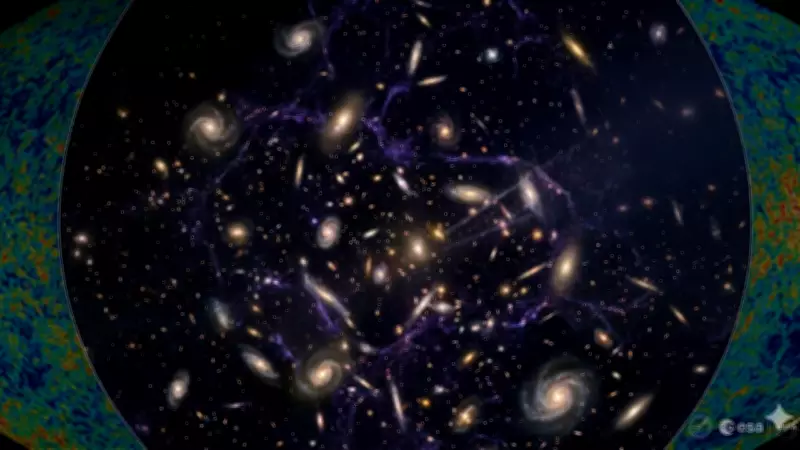
The Universe's Accelerating Expansion: A Cosmic Conundrum Deepens
Not only is the Universe expanding, but this expansion is occurring at a velocity that surpasses previous scientific expectations. For decades, physicists have endeavored to quantify the speed of galactic movement through the Hubble constant. However, conflicting measurement outcomes have presented a profound dilemma for modern physics, suggesting an inconsistency lurking within the fabric of our cosmos. This challenge, widely recognized as the "Hubble tension" problem, persists despite recent advancements and more precise observations, remaining largely unexplained.
The Mystery of Divergent Expansion Rates
The theory of an expanding Universe was first documented in 1929 by Edwin Hubble, yet contemporary findings reveal a startling divergence. Observations of the cosmic microwave background from the early Universe indicate a lower expansion rate, while studies of nearby galaxies show a significantly higher rate. As detailed in the research paper 'A Comprehensive Measurement of the Local Value of the Hubble Constant with 1 km s−1 Mpc−1 Uncertainty from the Hubble Space Telescope and the SH0ES Team' in Astrophysics, astronomers using the Hubble Space Telescope reported:
"The Hubble Constant is now determined with an uncertainty of less than 2.4%, yet the discrepancy with early-Universe predictions persists."

This disparity is not trivial; it is so substantial that scientists cannot attribute it solely to observational errors, pointing to deeper cosmic mysteries.
Why the Expansion Is Accelerating
Dark energy is a key phenomenon believed to drive this acceleration, constituting approximately 68% of the Universe. Despite its prevalence, the exact nature of dark energy remains enigmatic, representing the most critical unanswered question in cosmology. Some theories propose that dark energy may be time-dependent, which could potentially resolve the puzzle of varying expansion rates. This has even led to suggestions that entirely new physics might be required to fully comprehend these cosmic dynamics.
Could New Physics Solve the Puzzle?
The conflict among measurements has spurred scientists to investigate ambitious hypotheses, including revisions to Einstein's General Theory of Relativity or the existence of undiscovered matter and forces. A 2020 study titled 'Planck evidence for a closed Universe and a possible crisis for cosmology' by Nature Astronomy stated:
"If this tension does not result from systematic uncertainties, it can represent a case for new physics beyond the standard cosmological paradigm."
Such ideas have ignited extensive debate within the scientific community, with efforts focused on exploring possibilities like early dark energy or interactions among cosmic components to address the issue.
Future Prospects and Ongoing Investigations
Scientists are poised to leverage next-generation telescopes and space missions to gather more accurate data. Initiatives such as the James Webb Space Telescope and upcoming observational projects aim to refine calculations and propose novel hypotheses for testing. For now, the question of what causes the Universe to expand so rapidly remains open, with potential answers that could fundamentally reshape our understanding of reality.