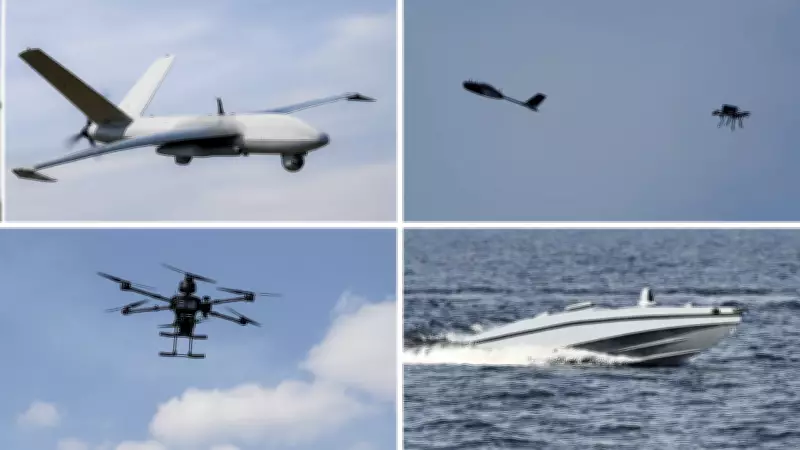
Ukraine has transformed itself into one of the world's largest drone warfare laboratories, moving beyond simple kamikaze strikes to deploy parachute-equipped reconnaissance UAVs, AI-guided swarms, and specialized naval systems. Kyiv now produces millions of drones annually, developing highly specialized aerial, naval, and ground systems designed for trench warfare, deep strikes, electronic warfare resistance, and Black Sea operations.
Drone Production Surge
According to Ukraine's defence ministry, the country produced more than four million drones in 2025 and aims to cross seven million units in 2026. The systems now range from cheap FPV strike drones to jet-powered long-range attack UAVs capable of penetrating hundreds of kilometres into Russian territory.

17 Drone Systems and Technologies Reshaping the Battlefield
- P1-SUN interceptor drones – High-speed quad-rotor interceptors that hunt enemy drones mid-air, particularly Iranian-designed Shahed loitering munitions. They climb rapidly toward targets and detonate using impact-fused explosive charges, increasingly integrated onto mobile launch platforms including aircraft and naval drones.
- AI-enabled FPV drones – Evolved from hobbyist systems into AI-assisted autonomous strike platforms with onboard vision computers that recognize and track vehicles or infantry even when Russian electronic warfare jams operator signals. Once locked, the drone continues its terminal attack autonomously.
- Hornet drones – Fixed-wing drones used by Ukraine's 1st Azov Corps for deep reconnaissance and precision strike. Built by US-based Swift Beat LLC, they use AI navigation and Starlink-backed communications for reliable long-range operations over occupied territories such as Donetsk.
- Mothership drone systems – Larger reusable drones that carry swarms of smaller FPV kamikaze drones, deploying them over enemy territory to dramatically extend operational range while reducing exposure of frontline drone pilots.
- RS-1 Bars jet-powered strike drones – A cheap cruise missile alternative powered by a jet engine, traveling at high speed and low altitude to evade Russian air defences. Designed for strategic deep strikes against fuel depots, command centres, and logistics infrastructure hundreds of kilometres inside Russia.
- Thermite 'Dragon' drones – Systems that drop burning thermite mixtures onto forested or entrenched Russian positions. Thermite burns at extremely high temperatures and is difficult to extinguish, used to ignite camouflage positions, destroy hidden ammunition, and flush troops out of tree lines.
- Linsa 3.0 VTOL reconnaissance drones – Developed through Ukrainian-German cooperation, combining quadcopter-style vertical take-off with fixed-wing cruise efficiency. Launches without runways for frontline reconnaissance, then transitions to fixed-wing flight for long-range surveillance.
- Heavy bomber drones ('Baba Yaga' and 'Nemesis') – Multi-rotor bombers feared by Russian infantry, especially at night. Systems like 'Baba Yaga' carry anti-tank mines, mortar rounds, and multiple improvised bombs to clear trenches, attack bunkers, and destroy armoured vehicles after dark.
- Anubis strike drones – Heavier AI-assisted strike drones for tactical battlefield attacks, designed to hunt armoured vehicles, troop concentrations, and hardened targets with larger payloads than standard FPV systems.
- Rocket-modified attack drones – Some Ukrainian strike drones modified to fire unguided rockets before conducting kamikaze attacks, intended to suppress or confuse mobile Russian air-defence systems moments before impact.
- MAGURA V5 naval drones – Unmanned surface vessels acting as maritime kamikaze drones capable of striking Russian warships, patrol vessels, and logistics ships in the Black Sea. Their attacks have forced Russia's Black Sea Fleet to reposition many assets away from Crimea.
- STING/Wild Hornets interceptor drones – Demonstrated a major milestone by destroying a Russian Shahed drone using an interceptor launched from a naval drone platform. Uses advanced communications and remote launch capabilities, allowing naval drones to function as floating anti-aircraft batteries.
- DELETEr interceptor drone – A fixed-wing interceptor featuring vertical take-off and parachute-assisted recovery. Cruises at around 170 km/h and can reach speeds of 260–270 km/h. If it fails to intercept, it automatically returns and lands using a parachute for reuse. Flies at altitudes up to 4,000 metres and operates in strong winds, costing roughly UAH 96,000. Parachute recovery reflects efforts to preserve expensive drones for repeated use.
- Sky Devil reconnaissance drone – Long-range reconnaissance drone designed to resist electronic jamming. Launches via catapult and returns using parachute recovery for safe landings on rough terrain, protecting onboard sensors and intelligence payloads.
- FlyEye and Leleka-100 reconnaissance drones – Systems such as the Polish-designed FlyEye and Ukraine's Leleka-100 frequently use parachute recovery mechanisms. They conduct deep surveillance missions behind enemy lines before descending gently using parachutes, enabling repeated reuse and data recovery.
- CS-01 parachute recovery system – Developed by Ukrainian firms Ukrspecsystems and UAS Components, a dedicated parachute system for drones carrying 8–12 kg payloads. Automatically switches damaged or malfunctioning drones into controlled descent mode for safe recovery at speeds of roughly 3–6 metres per second.
- MAGURA drone carriers and sea-launched drone swarms – Ukraine converts naval drones into mobile drone carriers that travel close to Russian positions before deploying 10–15 multirotor strike drones. Operators control them remotely from cities hundreds of kilometres away, creating floating launch bases for coordinated swarm attacks.
Why Parachutes Are Suddenly Appearing on Drones
Parachutes are becoming increasingly common on both Ukrainian and Russian drones because they allow UAVs to survive missions, recover intelligence data, and reduce operational costs. According to Ukrainian Air Force spokesperson Yurii Ihnat and UAV expert Serhii Beskrestnov ('Flash'), reconnaissance drones frequently deploy parachutes either on operator command or automatically after taking damage. This explains why soldiers often recover relatively intact enemy UAVs after crashes. Russian reconnaissance systems such as the Orlan-10, Orlan-30, and Supercam also use parachute recovery systems. Recent footage from Kharkiv reportedly showed damaged Russian reconnaissance drones descending safely by parachute after being hit. The growing use of parachutes highlights a broader shift in drone warfare: reusable drones are becoming as strategically important as disposable kamikaze systems.