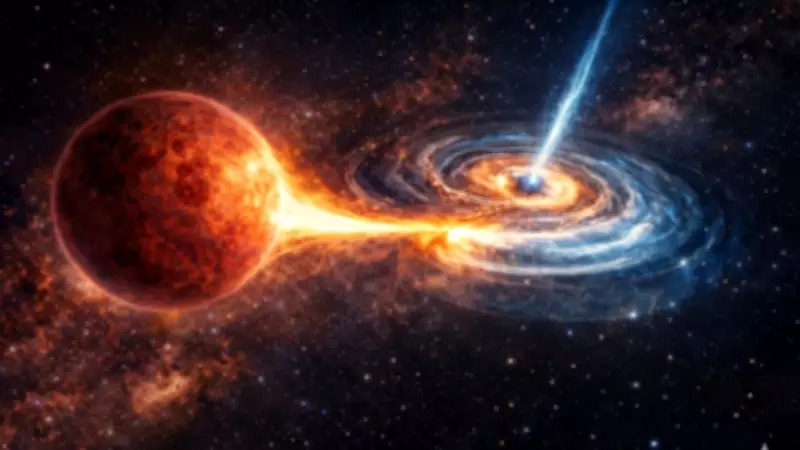
Cosmic Codependency: When Stellar Relationships Turn Toxic
We frequently attribute our failed relationships to fate or astrological alignments, blaming Mercury retrograde for breakups or cosmic timing for toxic encounters. However, the universe presents a profound parallel: stars themselves engage in destructive partnerships that mirror the unhealthy dynamics we experience on Earth.
The Universe's Unhealthy Relationships
Contrary to romantic notions of solitary stars, many exist in tightly bound binary systems, locked together by gravity for millions or billions of years. While some stellar partnerships remain stable and balanced, others descend into toxic codependency where one star systematically drains its companion.
These cosmic relationships demonstrate how imbalance and dependence can create destructive patterns, with one star becoming denser and more dominant while its partner steadily loses mass. Astronomers study these interactions because they reveal how stellar systems can turn violent over time, offering insights into extreme gravitational physics.

EX Hydrae: A Case Study in Cosmic Codependency
Approximately 200 light-years from Earth lies EX Hydrae, a binary system that perfectly illustrates stellar codependency. This system consists of a white dwarf—the dense remnant of a Sun-like star—and a main sequence companion. The white dwarf's intense gravity continuously draws gas away from its partner, creating a classic cosmic dependency relationship.
As this stolen material spirals inward, it heats up dramatically and releases powerful energy bursts. EX Hydrae belongs to a special class called intermediate polars, where the white dwarf's magnetic field disrupts but doesn't completely control the accretion disk, creating complex plasma structures that scientists have recently measured using NASA's Imaging X-ray Polarimetry Explorer.
Understanding White Dwarfs and Accretion
According to NASA, a white dwarf represents the dense, compact remnant left behind when a star like our Sun exhausts its nuclear fuel. Despite being roughly Earth-sized, a white dwarf contains mass comparable to our Sun, making it incredibly dense—a single teaspoon of white dwarf material would weigh several tons.
These stellar remnants no longer generate energy through fusion but emit residual heat while slowly cooling over billions of years. Many white dwarfs exist in binary systems where their strong gravity can pull material from companion stars, setting the stage for accretion phenomena, novae, and other energetic events.
The Accretion Process: Stellar Feeding Mechanisms
In astrophysics, accretion describes the process where massive objects gravitationally capture and accumulate material from their surroundings. This occurs across various cosmic environments, from young stars gathering gas in stellar nurseries to compact remnants like white dwarfs, neutron stars, and black holes drawing matter from nearby objects.
In interacting binary systems, accretion becomes particularly dramatic. When a white dwarf orbits close to a companion star, its intense gravity pulls gas from the companion's outer layers. This material typically forms a swirling accretion disk rather than falling directly onto the white dwarf. Friction and gravitational forces within this disk heat the gas to extreme temperatures, causing radiation emissions across the electromagnetic spectrum.
- In white dwarf systems, the accreted gas primarily consists of hydrogen
- As hydrogen accumulates on the white dwarf's dense surface, pressure and temperature increase steadily
- The white dwarf's degenerate matter cannot expand to cool, leading to continued pressure buildup
- Eventually, nuclear fusion occurs explosively in the accumulated layer, causing a nova outburst
When Cosmic Codependency Escalates
Many of the universe's most volatile relationships occur in binary systems containing white dwarfs. When such a star orbits close to a normal main-sequence star or swollen red giant companion, its extraordinary gravity begins pulling material from the companion's outer layers.

This stolen hydrogen spirals inward, forming a hot, glowing accretion disk. Over time, hydrogen buildup on the white dwarf's surface increases pressure and heat until the gas ignites in a runaway nuclear reaction, resulting in a sudden, dramatic brightening known as a nova.
The consequences can escalate dangerously. Repeated accretion can push a white dwarf toward the Chandrasekhar limit of 1.4 solar masses, potentially triggering a Type Ia supernova that completely destroys the star. Even without reaching this extreme, intense heating, magnetic stress, and violent matter infall create unstable conditions that threaten both stellar partners.
Cataclysmic Variables: Laboratories of Extreme Physics
NASA defines cataclysmic variables as close binary star systems where a white dwarf and donor star orbit closely enough for the white dwarf to pull material from its companion. This material typically forms an accretion disk around the white dwarf or follows its magnetic poles.
As gas accumulates on the white dwarf's surface, it heats up and can trigger thermonuclear explosions called novae, temporarily increasing the star's brightness without destroying it. These systems serve as important laboratories for understanding accretion, stellar evolution, and extreme gravity physics.
HM Sagittae: Another Toxic Stellar Relationship
NASA's Hubble Space Telescope has observed another striking example in HM Sagittae, a binary system where a white dwarf siphons material from a red giant companion. The white dwarf forms a hot accretion disk and launches energetic outflows, producing unpredictable eruptions, jets, and shocks.
Hubble observations reveal expanding gas clouds shaped by these interactions, offering rare insights into how prolonged stellar feeding can reshape entire regions of surrounding space. HM Sagittae demonstrates that long-term imbalance in stellar systems doesn't remain contained but alters both stars and their environment.
Stellar Diversity and Interactions
The universe hosts diverse star types that set the stage for cosmic interactions:
- Main sequence stars like our Sun fuse hydrogen into helium for billions of years
- Red giants expand when core hydrogen depletes
- White dwarfs represent dense remnants of Sun-like stars
- Neutron stars form from massive stars' supernovae
- Red dwarfs are small, long-lived stars
- Brown dwarfs are "failed stars" that never achieve full fusion
Our Sun's Future: A Solitary Path
Our approximately 4.6-billion-year-old Sun is nearly halfway through its estimated 10-billion-year lifespan. Currently a main sequence star steadily fusing hydrogen into helium, it will exhaust core hydrogen in roughly 5-6 billion years and expand into a red giant.
During this red giant phase, the Sun will begin fusing helium into heavier elements while hydrogen continues burning in shells around the core. Its outer layers will expand outward, likely engulfing Mercury and Venus while drastically altering Earth's environment.
After shedding its outer layers as a planetary nebula, the Sun will leave behind a white dwarf—a dense, slowly cooling stellar remnant roughly Earth-sized but with mass similar to its current self. Fortunately, our Sun's solitary nature protects it from the violent, codependent fate observed in binary systems like EX Hydrae or HM Sagittae.
These stellar partnerships reveal a cosmic dance where imbalance and dependence can prove destructive for both participants. While the white dwarf gains mass and energy from its companion—sometimes sparking dramatic novae or even Type Ia supernovae—the donor star steadily loses material and stability. Meanwhile, the accreting star risks overloading itself with catastrophic consequences.
Studying systems like EX Hydrae allows scientists to explore alternative stellar life cycles and gain deeper insights into what might happen under different circumstances. These cosmic relationships serve as fascinating reminders that in the universe, as on Earth, codependent dynamics carry significant consequences for all involved parties.