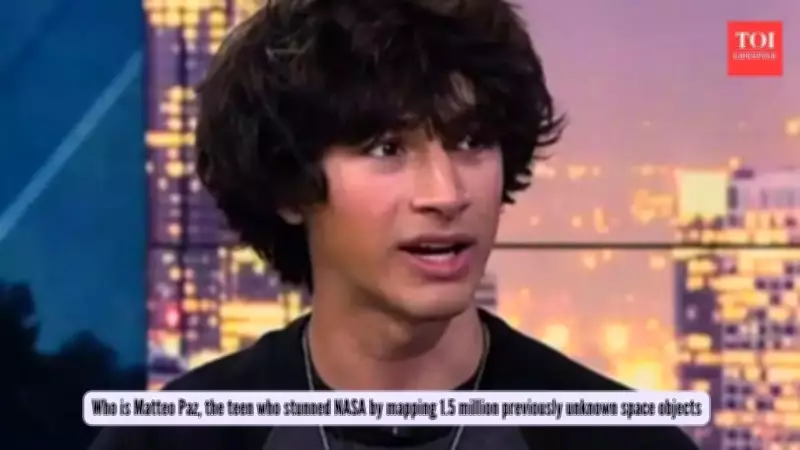
California High Schooler's AI Pipeline Transforms NASA Data into Groundbreaking Astronomical Discovery
A California high school student has captured global attention by leveraging artificial intelligence to extract profound insights from NASA's vast archival data, demonstrating how youthful curiosity can revolutionize our understanding of the cosmos. While space exploration often dominates headlines with multi-billion-dollar missions and International Space Station expeditions, this narrative serves as a powerful inspiration for aspiring young scientists worldwide.
Who Is Matteo Paz?
Matteo Paz, a diligent student at Pasadena High School, embarked on an extraordinary journey during a 2022 summer program at Caltech's Planet Finder Academy. Under the mentorship of scientist Davy Kirkpatrick at the Infrared Processing and Analysis Center (IPAC), Paz delved into NASA's NEOWISE dataset, a comprehensive infrared archive spanning over a decade and containing nearly 200 billion data rows focused on near-Earth asteroids and other celestial phenomena.
Developing an Innovative AI System
Rather than manually sifting through the immense dataset, Paz ingeniously constructed an AI pipeline in just six weeks. Utilizing his expertise in coding, theoretical mathematics, and time series analysis, his system adeptly identified subtle brightness variations in variable astronomical objects such as quasars, binary stars, and supernovae—changes that are typically imperceptible to human observation or conventional software tools.

"The model started showing promise almost right away," Kirkpatrick remarked in an interview. "As Paz fine-tuned it, the results only got more exciting."
How AI Managed Massive Data Through NASA Software
Launched in 2009, the NEOWISE mission conducted a full-sky survey, yet many faint signals remained concealed within its data. Paz's innovative system employed Fourier transforms and wavelet analysis to detect both gradual and transient brightness changes, culminating in a catalog of more than 1.5 million variable sources.
Published in The Astronomical Journal in late 2025, this catalog has become a valuable resource for astronomical observations at facilities like the Vera C. Rubin Observatory, providing fresh perspectives on stellar evolution and distant galaxies.
Collaboration and Recognition
Paz collaborated closely with Caltech experts, including Shoubaneh Hemmati, Daniel Masters, Ashish Mahabal, and Matthew Graham, to analyze the complete dataset. In early 2026, NASA leaders publicly commended his work, with Jared Isaacman highlighting how a teenager's AI achievements rivaled those of major laboratory efforts—even extending a job offer and an invitation for a jet ride.
From Classroom to Cosmos
Refined through Pasadena Unified's Math Academy, Paz's analytical tools are now suitable for graduate-level research. Kirkpatrick emphasized, "If I see their potential, I want to make sure they reach it. I'll do whatever I can to help them." The catalog's public release in 2025 has already sparked follow-up studies using the James Webb Space Telescope, further cementing its impact on the field of astronomy.