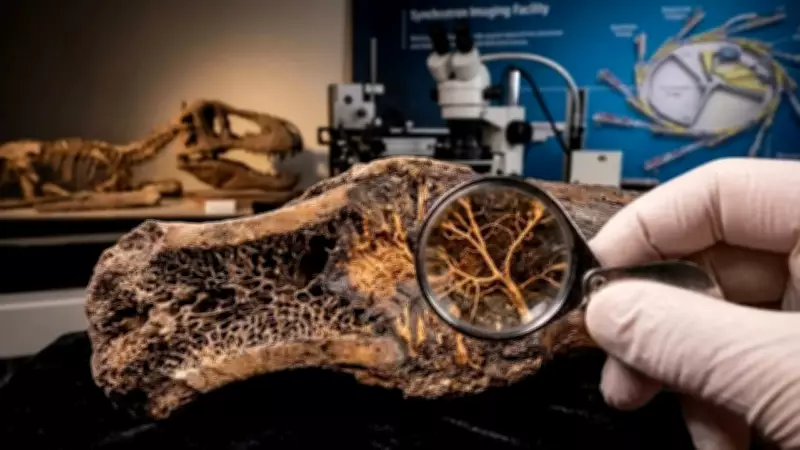
Palaeontologists have achieved a remarkable feat by using advanced X-ray technology to examine a 66-million-year-old injury on Scotty, the largest known Tyrannosaurus rex. They scanned one of Scotty's broken ribs with synchrotron micro-computed tomography. As a result, researchers discovered mineralised structures that look like tiny, branching networks, which are the remnants of ancient blood vessels. These findings give an exceptional insight into how top predators healed, revealing that iron minerals kept the shape of these blood vessels intact long after the actual tissue disappeared. This discovery closes the gap between lifeless fossils and the once-vibrant creatures they were, showing that even old wounds can reveal secrets about dinosaur biology.
T. rex Fossil Reveals Preserved Signs of Blood Vessels Inside Broken Bone
The study published in Nature looked at a particular lump of bone, known as a callus, that formed on one of Scotty's ribs during healing. At the Canadian Light Source, scientists used Synchrotron Micro-Computed Tomography to examine this fossilised bone in detail without causing any harm. They found an intricate network of what they called vessel casts. These were not actual tissues but rather mineralised imprints of blood vessels from 66 million years ago. When Scotty's rib was broken, his body immediately began repairing it by initiating angiogenesis, a process that creates new blood vessels to supply nutrients to the damaged area. Over time, these vessels were replaced by iron-rich minerals such as goethite and pyrite, capturing their original 3D form even after the organic material had decayed away.
Synchrotron Tech Mapped Prehistoric Vessel Networks
According to the study published in Nature, scientists achieved a major discovery by merging 3D X-ray imaging with X-ray Fluorescence (XRF) mapping. This technique enabled them to identify the unique chemical fingerprints of minerals within the blood vessels. The study revealed that these vessel-like structures possessed a distinct chemical signature when compared to the surrounding bone matrix. Consequently, this confirmed that they were part of a biological system, not merely cracks in the rock.

Evidence of High Metabolic Rates in T. rex
This finding isn't just about a fascinating image. It actually provides strong evidence of a high metabolic rate and a strong immune system. The way Scotty's rib shows dense and complex blood vessels indicates these dinosaurs had recovery systems like those of today's birds and mammals. Even though Scotty suffered many serious injuries during its life, its body could regenerate bone efficiently, helping it remain a top predator.
Why Scotty Is Unlike Any Other Fossil
Scotty, also known as Specimen RSKM P2523.8, stands out due to its impressive age and size. Unlike most fossils that appear clean, Scotty's bones tell tales of a rough existence, with signs of battles like impacted teeth from other dinosaurs and multiple fractures. Interestingly, this research on the rib fracture marks a groundbreaking achievement. It is the first occasion where scientists have recorded an extensive vascular network in a dinosaur's healing wound; this discovery links palaeontology with modern pathology in a novel way.