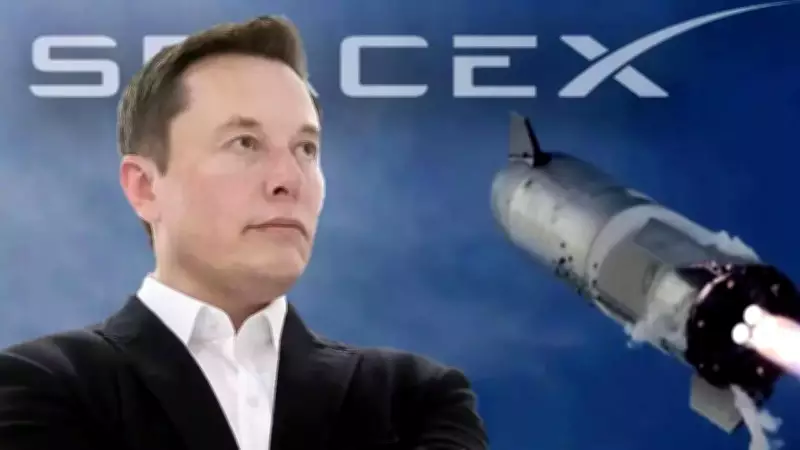
Elon Musk's SpaceX is on the verge of making history with a potential initial public offering (IPO) that could reshape aerospace engineering. The private space giant has officially submitted its Form S-1 paperwork with the US Securities and Exchange Commission (SEC), revealing plans to list on the Nasdaq stock exchange under the ticker symbol SPCX. The filing confirms Wall Street rumors: Musk is taking his rocket and satellite empire public, aiming for a valuation between $1.75 trillion and $2 trillion.
Massive Growth, Deep Losses
For over two decades, SpaceX's internal finances were kept secret. The S-1 filing offers the first unrestricted look into its financials. SpaceX generated $18.7 billion in revenue in 2025, a 33% year-over-year increase, driven by dominance in the global launch market and satellite broadband adoption. However, the company posted a net loss of $4.94 billion for 2025, and losses accelerated to $4.27 billion in the first quarter of 2026 alone.
While losses were assumed to stem from Starship development, the filing reveals that heavy investments in its new AI unit, following the acquisition of xAI, are the primary cause. SpaceX has transformed into a deep-tech hybrid, requiring massive capital for AI microchips, data centers, and engineers.

Starlink: The Cash Cow
Starlink, SpaceX's satellite internet service, now accounts for roughly 60% of total revenue, generating over $11 billion in 2025. The network has expanded beyond residential subscriptions to lucrative enterprise markets, including commercial aviation, maritime networks, and defense contracts. Starlink's success makes SpaceX fundamentally different from traditional aerospace contractors, offering recurring software-like margins.
Elon Musk's Total Control
To protect his long-term vision, Musk has implemented a super-voting share structure. Public shares will carry one vote per share, while insider shares held by Musk and select shareholders will have 10 votes per share, ensuring control over board elections and corporate decisions. Musk, already worth $839 billion, could become the world's first trillionaire if the IPO succeeds.
Risks and Rewards
The IPO aims to raise at least $75 billion, providing capital for AI scaling, Starlink expansion, and Starship mass production. However, the pivot into AI introduces fiscal volatility, as seen in Q1 2026 losses. A deal with Anthropic to rent AI computing capacity for $1.25 billion per month highlights potential monetization. The recent Starship launch, despite a booster loss, has reassured investors of progress. The IPO is expected to be a landmark event in human history.