Space agencies worldwide are preparing for ambitious missions to the Moon and Mars. While the stakes and ambitions are high, a persistent practical problem remains: how to provide astronauts with fresh medicines during journeys millions of miles from Earth. A new study from the University of California San Diego suggests that the solution may lie in a small greenhouse.
Plants as Mini Pharmaceutical Factories
A team at UC San Diego has demonstrated that plants could be used as miniature pharmaceutical factories in space, producing drugs on demand for astronauts. This is crucial because in deep space, supply drops are impossible, and medicines degrade faster due to cosmic radiation and storage conditions. Over half of the medications stored on the International Space Station do not last three years. Since a round-trip to Mars could take longer, stockpiling all possible medicines is impractical.
Plants are already considered essential for future space colonies as they produce food, recycle air, and manage water. This study suggests they could soon take on the additional role of medicine production.

How It Works
Researchers used the cowpea mosaic virus (CPMV) as a test subject. This virus targets legumes but has been studied for its ability to stimulate the immune system and fight cancer in animal models. The team grew CPMV in two plant species: Nicotiana benthamiana and black-eyed peas. Both are fast-growing and produce high biomass, making them ideal for large-scale production.
Traditionally, extracting medicine from plants involves grinding leaves, which is messy, equipment-intensive, and generates waste—unsuitable for a spacecraft. The UCSD team used a different approach. Instead of destroying the plants, they harvested medicine from the apoplast, a spongy zone outside plant cells. They soaked leaves in solution, applied a vacuum to draw in more liquid, then gently spun the leaves to collect the medicine-rich fluid, leaving the leaves intact. This method is quick, clean, and allows the plant to continue growing.
The team could harvest medicine from over 50 plants in less than two hours without killing them. In space, this means a renewable supply of fresh drugs growing alongside lettuce.
Performance in Simulated Space Conditions
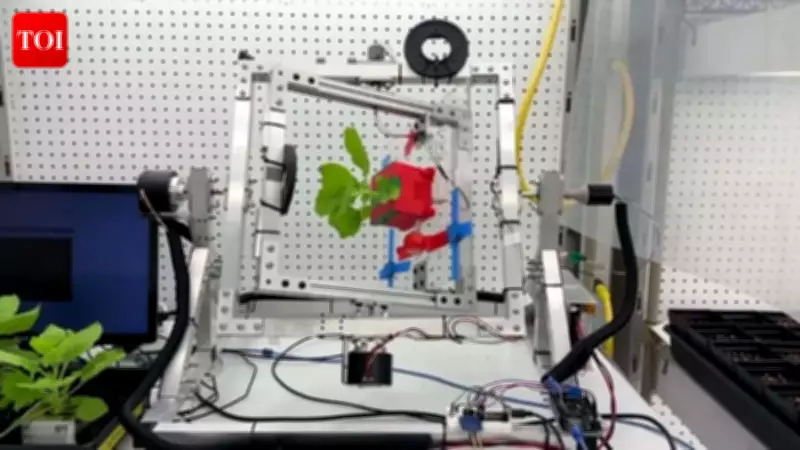
To test the concept under space-like conditions, the team placed plants on a rotating machine to mimic microgravity, along with temperature fluctuations and stress. Surprisingly, the “space stress” slightly increased medicine production, possibly because stressed plants are more vulnerable to the virus, which enhances production of medicinal particles. Thus, even in harsh simulated space conditions, the pharmaceutical garden performed well.
Next Steps
This concept is still in early stages. The team is now investigating how real microgravity affects plant health, roots, water uptake, and drug production, as well as the impact of rocket launches on seeds. There is growing interest in small greenhouses on spacecraft where crews can grow drugs as needed, rather than relying on medicines packed years in advance.
While astronauts are not yet growing pharmacies among the stars, this research brings us closer to a future where Mars explorers depend on plants not only for food and air but also for life-sustaining medicines.