The Crimson Warning: How a Solar Storm Lit Up Ladakh's Night Sky
The pristine skies above Hanle in Ladakh are renowned for their profound darkness, a celestial canvas so deep and clear that stars appear not as twinkling specks but as sharp, steady points of light. This remote region, far from urban glare and atmospheric pollution, offers astronomers some of the world's best views of the cosmos. However, on the nights of January 19 and 20, this tranquil darkness was dramatically shattered by an otherworldly phenomenon.
An Unsettling Glow in the Himalayas
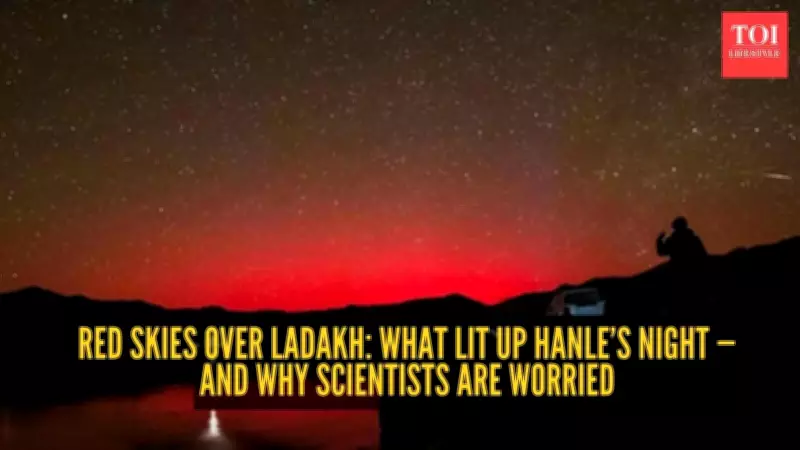
Instead of the familiar blue-black expanse, the sky above Hanle erupted in a deep, unsettling crimson glow. This was not a gentle or subtle illumination but a vivid, intense red that seemed alien against the Himalayan backdrop. Photographs of the event quickly spread across social media, with many users dubbing it the "Northern Lights over India." While visually stunning, this spectacle carried a far more serious message about our Sun's increasing activity.
What observers witnessed was not merely a rare atmospheric display but the visible signature of the most intense solar radiation storm since 2003. The event originated from a powerful X-class solar flare that erupted on January 18, unleashing a massive Coronal Mass Ejection (CME) toward Earth. This cloud of superheated plasma, traveling at nearly 1,700 kilometers per second, reached our planet in just about 25 hours.

The Science Behind the Red Sky
The impact triggered a severe G4-level geomagnetic storm, causing Earth's magnetic shield to compress under the assault of charged solar particles. At altitudes exceeding 300 kilometers, these particles excited oxygen atoms, producing the distinctive red aurora visible from Ladakh. Unlike the green auroras typically seen near the poles, regions like Hanle, located farther south, captured the upper red edges of this geomagnetic disturbance.
Scientists from the Indian Space Research Organisation (ISRO) warn that such events may become more frequent as the Sun approaches its solar maximum, the peak of its roughly 11-year activity cycle. The January 2026 storm was classified as an S4-level radiation storm, indicating a dangerous surge of high-energy protons from the Sun.
Infrastructure at Risk: Satellites, Power Grids, and More
The implications extend far beyond celestial photography. Data from India's Aditya-L1 mission revealed that during the storm's peak, Earth's magnetosphere was pushed alarmingly close to the planet, briefly exposing even geostationary satellites to harsh solar winds. These satellites are critical for communication, weather forecasting, and navigation.
For India, the risks are immediate and tangible. Severe geomagnetic storms can induce electric currents in power grids, potentially damaging transformers and causing widespread blackouts. They can also heat and expand the upper atmosphere, increasing drag on satellites and disrupting GPS systems, flight navigation, internet networks, and digital banking services. During this event, astronauts on the International Space Station were forced to seek shelter in shielded areas due to spiking radiation levels.
India's Defense Against Solar Threats
Early warning systems are crucial for mitigating these risks. The Aditya-L1 spacecraft, positioned at the L1 Lagrange point about 1.5 million kilometers from Earth, provides continuous solar monitoring. When a CME is detected, scientists gain a vital day or two of lead time to take protective measures, such as placing satellites in safe mode or adjusting power grid loads to prevent damage.
On the ground, engineers are strengthening infrastructure by installing sensors to monitor geomagnetically induced currents in real time. Meanwhile, the Indian Astronomical Observatory in Hanle, located within India's first officially recognized dark sky sanctuary, plays a key role in validating satellite data with ground-based observations. Preserving Hanle's darkness is not just an aesthetic concern but a practical necessity for maintaining this vital window into space weather.

A Wake-Up Call From the Cosmos
The red sky over Ladakh served as both a breathtaking natural wonder and a stark reminder of our technological vulnerability. As the Sun enters a more active phase, the need for robust space weather forecasting and resilient infrastructure becomes increasingly urgent. While the crimson glow has faded, its warning echoes loudly: our interconnected world must prepare for the Sun's restless tantrums.