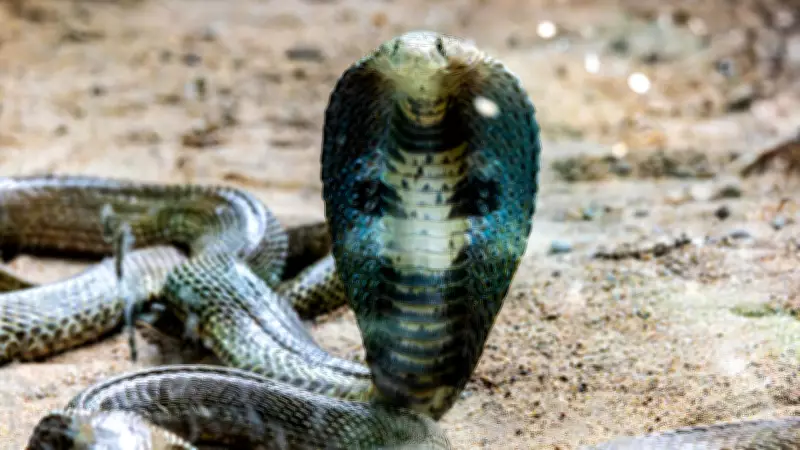
Snakes Defy Gravity: Upright Posture Explained by Smart Muscle Control
On the surface, it seems counterintuitive for a snake to stand upright, as these limbless reptiles lack the skeletal rigidity and balance aids common in other animals. For decades, this unique behavior puzzled scientists, but recent interdisciplinary studies combining biology, physics, and mathematics are now shedding light on how snakes achieve this gravity-defying feat. The process involves far more than mere strength, revealing a sophisticated system of energy conservation and precise muscular coordination.
Snake Upright Posture: Not Strength, but Smart Muscle Control
The most fascinating discovery about these reptiles is that they do not exert effort across their entire bodies. Instead, muscular activity is concentrated at the bottom part, where the snake makes contact with a surface and pushes off. This creates a "boundary layer" where most of the work occurs, while the rest of the body remains almost straight and vertical with minimal muscular strain.
Research published in the study "Postural control in an upright snake" demonstrates how snakes save energy by avoiding full-body tension. By focusing control on essential areas, they maintain stability and balance, enabling some species to lift up to 70 percent of their bodies vertically. This efficient approach highlights an evolutionary adaptation that prioritizes optimal energy expenditure over brute force.

Physics of Snake Movement: How They Defy Gravity
This trick also relies heavily on the laws of physics. When a snake forms a near-vertical angle, its weight alone is insufficient to keep it grounded, reducing the need for additional muscular effort to support the head. From the "mechanics of slithering locomotion," snakes are described as "muscular ropes" capable of forming complex positions based on a key principle: less tension minimizes the risk of breakdown.
To achieve an upright posture, snakes typically bend in an S-shape near their lower end while stretching the remainder of their body upward, resembling an optimal engineering structure. However, maintaining this erect position is challenging, requiring continuous balance adjustments that result in slight wobbling movements observed in some species.
New Research on Snakes: Insights from Biology and Robotics
The latest findings, from joint studies in the Journal of the Royal Society Interface, involve collaboration among biologists, physicists, and engineers. Experiments with animals like brown tree snakes and scrub pythons, observed crossing distances between raised platforms, led to mathematical equations modeling the snake as an "active elastic filament"—a soft object that senses and reacts to its environment.
Scientists explain that the combination of muscular activation and proprioception allows snakes to solve complex balancing problems without solid support. Beyond enhancing biological understanding, these insights are valuable for engineering applications, inspiring snake-inspired robots designed to navigate difficult environments such as disaster sites or outer space. In essence, balancing like a snake emphasizes optimal energy use rather than sheer strength.