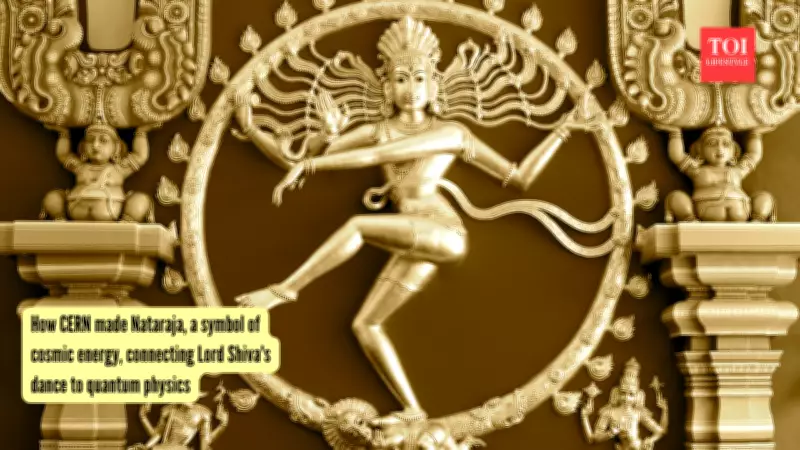
Lord Shiva embodies multiple forms—creator and destroyer, Neelkantha with poison in his throat, and Natraja as the Cosmic Dancer. Among these, the Nataraja form stands out as a profound philosophical symbol, representing Shiva performing the Tandava, the rhythm of existence itself. This depiction shows a bronze figure encircled by a ring of fire, one foot pressing down on ignorance, the other lifted in grace. In one hand, he holds a drum that beats the sound of creation, while the other hand holds a flame symbolizing destruction. His flowing hair and differing earrings represent the union of male and female, illustrating that divinity transcends gender.
Shiva's Nataraja at CERN: A Symbol of Unity
Remarkably, a bronze statue of Lord Shiva in his Nataraja form stands at CERN, the world's premier particle physics laboratory in Switzerland. Some question its presence, viewing it as an odd addition to a place dedicated to rational inquiry. However, this connection is deeply meaningful. The dance of Shiva and the mysteries of quantum physics share profound parallels that bridge science, philosophy, and art.
How Nataraja Embodies Cosmic Energy
Quantum physics, with its wave-particle duality and probabilistic nature, often challenges Western thought, which relies on clear-cut distinctions. Concepts like being both a particle and a wave, or reality being probabilistic rather than deterministic, are difficult to grasp within an either-or logical framework. This is why many great scientists, including Robert Oppenheimer and Erwin Schrödinger, turned to Eastern philosophy for insights. Vedanta, a school of Hindu philosophy that embraces paradox and interconnectedness, offers a way to understand the coexistence of creation and destruction. This aligns with quantum mechanics, where subatomic particles are interconnected and influence each other instantaneously.

The Statue's Journey to CERN
On June 18, 2004, the Indian government gifted the Shiva statue to CERN, where it was unveiled with great reverence. The statue is not an intrusion of religion into science but an acknowledgment that art, philosophy, and science are interconnected ways of understanding existence. The Tandava dance represents the eternal cycle of creation and destruction, mirroring the processes physicists study when examining subatomic particles colliding and transforming. A plaque at the site quotes physicist and philosopher Fritjof Capra, whose book The Tao of Physics explores parallels between Eastern mysticism and modern physics. Capra identified that the fundamental forces governing the universe are the same as those depicted in Shiva's dance, seeing particle interactions as the rhythmic energy described in Hindu scriptures.
The Five Concepts of Cosmic Existence
Within the cosmic ring of fire, Nataraja's form embodies five concepts: Srishti (creation), Sthiti (preservation), Samhara (destruction), Tirobhava (illusion), and Anugraha (liberation). His upper right hand holds a damaru, a small hourglass-shaped drum, beating the primal sounds of creation. Hinduism teaches that creation originates as sound or vibration, a concept that Fritjof Capra linked to quantum theory, where all matter vibrates at the atomic level. His lower right hand makes the abhaya mudra, a gesture of fearlessness symbolizing preservation. His upper left hand holds a blazing flame, representing the power of destruction.
Interconnectedness of Art and Science
The Shiva statue at CERN signifies that philosophy and science are not separate domains but interconnected ways of understanding existence. Just as Shiva's dance represents the rhythm of existence, physicists explore the dynamic nature of reality through their experiments. When they study particle interactions, they witness a dance of energy at the most fundamental level.