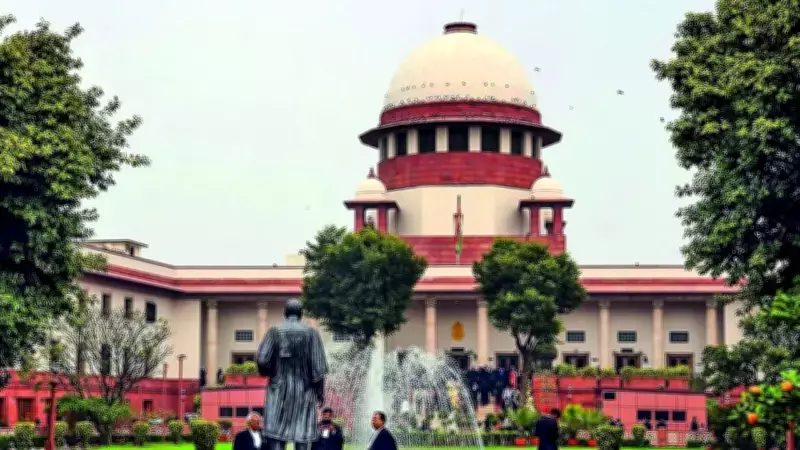
The Supreme Court witnessed a thought-provoking argument as a rationalist organisation asserted that Article 25 of the Constitution, which guarantees freedom of conscience and the right to freely profess, practice, and propagate religion, permits a person to wake up as a Hindu, have lunch as a Muslim, and go to sleep as a Christian.
Senior advocate Sanjay Hegde, representing rationalists Hamid Dabholkar and Nandini Jadhav of the Maharashtra Andhashraddha Nirmoolan Samiti, presented this view before a nine-judge bench led by Chief Justice Surya Kant. Hegde argued that every individual, according to their conscience, can profess and practice any religion at any time of the day.
Justice Ahsanuddin Amanullah raised concerns, stating that such an interpretation could lead to absurdity, as a person might claim to be a Muslim but become a Hindu to enter a temple. He questioned whether one could simultaneously profess Islam, practice Hinduism, and propagate Christianity, calling it a dangerous proposition.

Undeterred, Hegde maintained that if places of worship are excluded, a person can exercise their right to freedom of conscience in this manner. He emphasised that God does not discriminate and cited the folklore of Bhakta Salabega, a Muslim devotee whose devotion reportedly stalled Lord Jagannath's chariot during the Rath Yatra after being denied participation.
Justice B V Nagarathna questioned whether the morale of such stories lies in unqualified devotion, and whether a non-devotee could challenge the validity of a religious practice or custom. Hegde responded that tradition cannot trump the Constitution. A rationalist holds reason as the proper test of belief, rejecting the notion that what is old must be true or that the sacred is exempt from inquiry. The Constitution protects religious autonomy in intrinsically religious matters like doctrine and ceremony, but not in secular matters associated with religion.
Supporting the Supreme Court's 2018 judgment that quashed restrictions on women aged 10-50 entering the Sabarimala Ayyappa temple, Hegde argued that a denomination cannot continue a practice that is discriminatory towards women in their prime years. He stated that when an individual's equal worship right under Article 25(1) conflicts with a denomination's exclusion claim under Article 26(b), the individual right prevails, as Article 25(1) is explicitly made equally available to all persons.