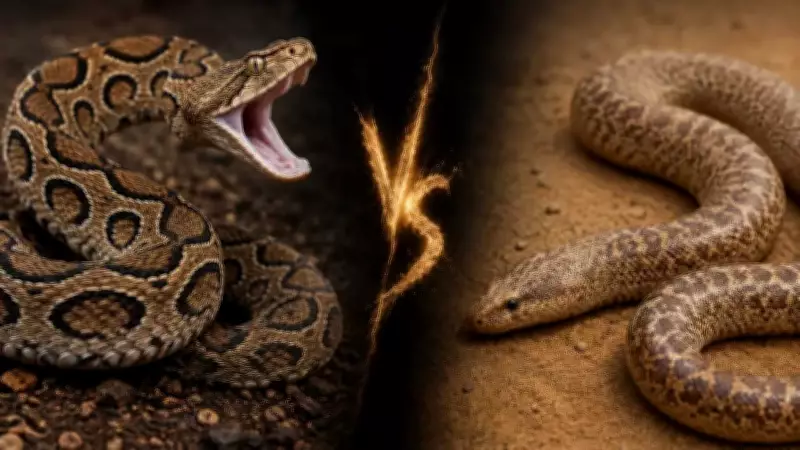
In parts of India, few snake identification mistakes are as common as confusing a Russell's viper with a common sand boa. At first glance, the resemblance can seem convincing. Both species often display brown or tan bodies marked with darker patches, and both may be encountered in dry agricultural landscapes. Yet the similarity is largely superficial. One is among South Asia's most medically significant venomous snakes, while the other is a harmless burrowing reptile that poses no threat to people.
The confusion has persisted for years, particularly where brief sightings leave little time for careful observation. Looking beyond colour patterns reveals important differences in body structure, behaviour, movement and ecology. Understanding these distinctions helps reduce unnecessary fear of harmless snakes while also encouraging caution around genuinely dangerous species.
Russell's viper vs Common sand boa: Appearance, behaviour and habitat comparison
Parameter
- Russell's viper
- Common sand boa
Scientific name
- Daboia russelii
- Eryx conicus
Venom
- Highly venomous
- Non-venomous
Head shape
- The broad triangular head is distinct from the neck
- Small, blunt head barely distinct from neck
Body build
- Thick and muscular
- Short, stout and cylindrical
Tail
- Gradually tapering
- Short, blunt tail resembling a second head
Scales
- Strongly keeled and rough
- Rough but less pronounced, adapted for burrowing
Colour pattern
- Large oval dark spots bordered by lighter edges
- Irregular blotches and patches, often variable
Behaviour
- Defensive and capable of loud hissing
- Usually calm and secretive
Habitat
- Grasslands, farmland, scrub and open country
- Sandy soils, loose earth and dry scrublands
Activity
- Mainly nocturnal but sometimes active by day
- Mostly nocturnal and spends much time underground
Diet
- Rodents, lizards and small animals
- Rodents, lizards and small vertebrates
Risk to humans
- Potentially life-threatening bite
- Harmless to humans
Key differences between Russell's viper and common sand boa
Venom
The most important distinction is venom. Russell's viper possesses potent venom capable of causing severe medical emergencies and requires immediate treatment if a bite occurs. The common sand boa lacks venom glands and kills prey through constriction. Bites from sand boas may startle people, but they are generally harmless.

Head shape
A Russell's viper usually has a broad, triangular head that stands out clearly from the neck. This shape is typical of many vipers. The common sand boa looks quite different, with a rounded, blunt head that blends smoothly into the body, making the neck difficult to distinguish.
Body build
Both snakes appear stout, which contributes to confusion. Russell's vipers have a heavily built body with a muscular appearance suited to ambush hunting. Sand boas are shorter and more cylindrical, reflecting their underground lifestyle and tendency to move through loose soil rather than across open ground.
Tail
The tail often provides one of the easiest clues. Russell's vipers have a conventional tapering tail. Sand boas possess a remarkably blunt tail that resembles the head from a distance. This unusual feature is believed to help distract predators and is frequently described as a "double-headed" appearance.
Scales
Russell's vipers have strongly keeled scales that create a rough texture and contribute to their rugged appearance. Sand boas also possess rough scales, particularly in the rough-scaled species, though these are linked more closely to burrowing efficiency than to the defensive adaptations seen in vipers.
Colour pattern
Colour alone can be misleading. Russell's vipers usually display rows of distinct oval spots running along the body, often outlined by lighter borders. Sand boas may show similar brown blotches, which explains the confusion, but the markings tend to be less regular and more variable.

Behaviour
When disturbed, Russell's vipers often become highly defensive. They may coil, raise part of the body and produce a loud warning hiss before striking. Sand boas generally rely on concealment. Rather than confronting threats, they often attempt to remain hidden or retreat beneath loose soil.
Habitat
Russell's vipers thrive in open countryside, farmland, scrubland and grassy areas where rodents are abundant. Common sand boas favour loose sandy soils, dry scrub and semi-arid habitats. Although their ranges overlap in some regions, their preferred microhabitats often differ considerably.
Activity patterns
Both snakes are largely active after dark, yet their lifestyles remain distinct. Russell's vipers spend much of their time above ground searching for prey or waiting in ambush. Sand boas are far more secretive and frequently remain buried for long periods, emerging mainly when conditions are favourable.
Diet
Rodents form a significant part of the diet for both species. Russell's vipers also consume lizards and other small animals. Sand boas feed on similar prey but usually capture it in confined spaces or near burrows, reflecting their underground habits and slower hunting style.
Risk to humans
Encounters with Russell's vipers demand caution because their venom can cause serious illness and requires urgent medical care. Common sand boas present no comparable danger. In fact, they are often beneficial in agricultural landscapes because they help control rodent populations naturally.
Russell viper vs Common sand boa: Comparing two frequently misidentified snakes
Although the common sand boa and Russell's viper can appear similar from a distance, a closer look reveals clear differences in head shape, tail structure, behaviour and danger level. The sand boa's blunt tail, secretive nature and lack of venom contrast sharply with the viper's triangular head, defensive display and medically significant bite. Learning these distinctions not only improves identification in the field but also helps prevent the unnecessary killing of harmless snakes while promoting safe behaviour around genuinely venomous species.