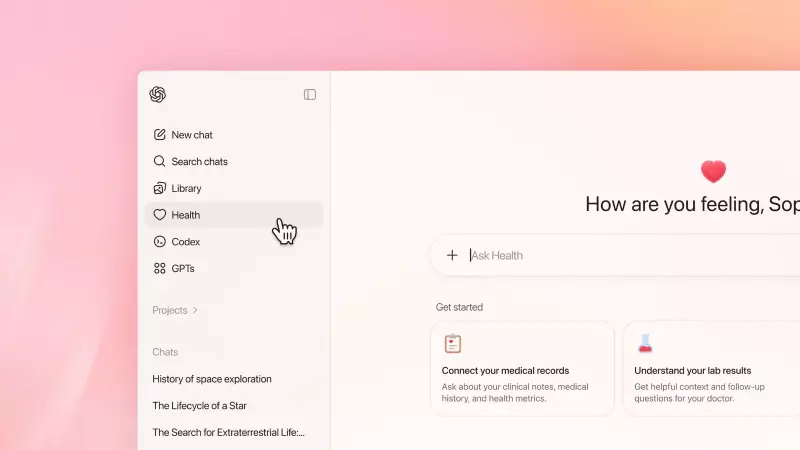
In a significant move blending artificial intelligence with personal healthcare, OpenAI announced the launch of ChatGPT Health on Wednesday, January 8. This new, dedicated experience within the popular chatbot is designed to function as a personalised wellness assistant by securely integrating a user's own health data.
What is ChatGPT Health and How Does It Work?
The core promise of ChatGPT Health is to deliver more relevant and useful health information by grounding conversations in a user's specific medical history. Users can now securely connect their medical records and data from various wellness applications directly to the chatbot. OpenAI states that this fusion of personal health information with ChatGPT's intelligence aims to help individuals feel more "informed, prepared, and confident" when navigating health-related questions.
Fidji Simo, the CEO of Applications at OpenAI, positioned this launch as a strategic step. In a Substack post, she wrote, "ChatGPT Health is another step toward turning ChatGPT into a personal super-assistant that can support you with information and tools to achieve your goals across any part of your life." Simo also shared a personal anecdote that fueled her advocacy for AI in healthcare, criticising the current system for failing both patients and doctors.

Strong Privacy and a Clear Purpose: Support, Not Diagnosis
Understanding the sensitivity of health data, OpenAI has emphasised robust security for this feature. ChatGPT Health operates in a dedicated, isolated space within the chatbot, where all connected files, apps, and conversations are stored separately from other chats. The company employs purpose-built encryption and asserts that information from ChatGPT Health will not flow outside this compartmentalised space. Crucially, these conversations will not be used to train OpenAI's foundation models.
The company is clear about the tool's purpose and its limits. ChatGPT Health is not intended for medical diagnosis, treatment, or to replace care from qualified clinicians. Instead, it is built to assist users in understanding and managing their wellness, helping them navigate everyday health questions with responses tailored to their connected information. The feature was developed in close collaboration with physicians.
The Growing Trend of AI in Healthcare
OpenAI's launch taps into a rapidly growing trend. The company revealed that health is already one of the most common use cases for ChatGPT, with hundreds of millions of health-related queries posed weekly. Backing the need for such tools, Simo cited an American Medical Association finding that physician use of AI nearly doubled from 2023 to 2024, with 68% acknowledging it offers an advantage in patient care.
Further evidence comes from an OpenAI-commissioned survey, which found that three in five adults in the US used AI tools for health purposes in the past three months, and 75% of those users found the experience very or extremely helpful.
To enable the secure connection of medical records, OpenAI has partnered with the digital health platform b.well. This collaboration will initially allow users in the United States to authorise access and connect their health data from US healthcare providers directly within ChatGPT. The integration is designed to give consumers control over where and how they access their health information securely.
For users in India and globally, the launch of ChatGPT Health signals a future where AI assistants could become deeply integrated into personal health management, provided similar data connectivity frameworks evolve in other regions. It underscores a shift towards AI-powered, proactive wellness support, while carefully navigating the critical boundaries of privacy and professional medical care.