

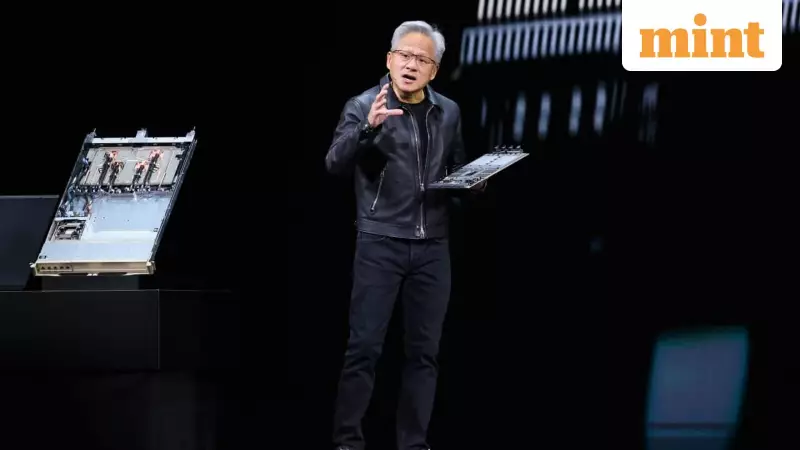
In a significant development for the global technology sector, Nvidia CEO Jensen Huang announced on Saturday that the company is witnessing exceptionally strong demand for its cutting-edge Blackwell chips, the powerful processors driving the current artificial intelligence revolution.
Unprecedented Demand for Advanced AI Chips
Speaking at a TSMC event in Hsinchu, Huang emphasized that the skyrocketing demand for Blackwell chips is creating a domino effect, significantly increasing the need for wafers from Taiwan Semiconductor Manufacturing Co., Nvidia's long-standing manufacturing partner. "TSMC is doing a very good job supporting us on wafers," Huang acknowledged, stressing that Nvidia's remarkable success would be impossible without TSMC's crucial support.
This marks Huang's fourth public visit to Taiwan this year, occurring as the semiconductor giant confronts market share losses in China. These challenges stem from ongoing tariff tensions between Washington and Beijing, which have restricted the sale of Nvidia's most advanced AI chips to the Chinese market.

Supply Chain and Manufacturing Dynamics
Huang provided detailed insights into the complex supply chain supporting Nvidia's operations. "Nvidia builds the GPU, but we also build the CPU, the networking, the switches, and so there are a lot of chips associated with Blackwell," he explained to reporters. TSMC CEO C.C. Wei confirmed that Huang had specifically requested additional wafers, though the exact quantity remains confidential.
Regarding potential memory shortages, Huang expressed confidence in Nvidia's robust support system. "We have three very, very good memory makers - SK Hynix, Samsung, Micron - are all incredibly good memory makers, and they have scaled up tremendous capacity to support us," he stated. The chipmaker has already received the most advanced chip samples from these three memory partners.
When questioned about possible memory price increases, Huang diplomatically noted that "It's for them to decide how to run their business." This comment comes as SK Hynix revealed it has sold out all its chip production for next year, while Samsung Electronics is in close discussions to supply its next-generation HBM4 chips to Nvidia.
Geopolitical Implications and Market Restrictions
Despite overwhelming global demand, Nvidia faces significant limitations in selling its flagship Blackwell chips to China. Huang clarified on Friday that there are "no active discussions" about selling these advanced AI chips to Chinese customers, directly resulting from Trump-era restrictions aimed at preventing technological advancement in China's military and AI sectors.
In response to these restrictions, the Chinese government has implemented official guidance requiring new state-funded data center projects to use domestic artificial intelligence chips, creating further segmentation in the global semiconductor market.
The industry milestone achieved in October, when Nvidia became the first company to reach a $5 trillion market value, was celebrated by TSMC's Wei, who affectionately referred to Huang as a "five-trillion-dollar man." This achievement underscores the critical role both companies play in powering the ongoing artificial intelligence transformation across global industries.






