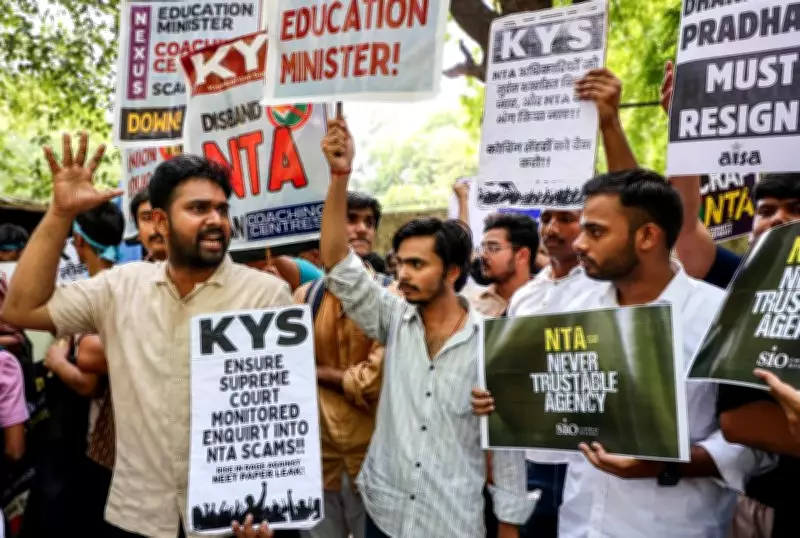
The National Testing Agency (NTA) was established to simplify and standardize entrance examinations for students across India. However, it has become embroiled in controversies involving paper leaks, exam cancellations, technical failures, and allegations of irregularities. The original intent was to address a fragmented admission system where students had to appear for multiple entrance exams conducted by various boards, universities, and regulators.
The Path to a Unified Testing System
For years, students seeking admission to medical, engineering, and higher education institutions had to navigate a maze of entrance examinations. The Central Board of Secondary Education (CBSE) conducted exams like AIPMT, AIEEE, and later JEE Main, while universities and professional bodies ran their own tests. This system suffered from duplication, varying standards, and an excessive burden on students.
NEET: A Turning Point
The push for a common testing framework gained momentum with the introduction of the National Eligibility-cum-Entrance Test (NEET) in 2012. The goal was to replace multiple medical entrance exams with a single national test, creating a uniform merit-based admission process. However, the plan faced legal challenges. In July 2013, the Supreme Court struck down NEET, restoring the earlier system of multiple exams. Three years later, in April 2016, a Constitution Bench overturned that decision, reviving NEET and reopening the path toward a centralized entrance test. At that point, the government argued that CBSE, which had been conducting major entrance exams, should no longer bear that responsibility, and a new agency was needed.

Birth of the NTA
The Union Cabinet approved the creation of the NTA on November 10, 2017. The agency was registered in May 2018 as a society under the Societies Registration Act, 1860, and took charge of major examinations, including JEE Main, NEET, and UGC-NET. The objectives were to create a specialized testing body, reduce the burden on CBSE, leverage technology for efficiency, and enhance transparency and standardization in entrance exams.
Legal Standing: A Problematic Framework
Unlike statutory bodies such as the University Grants Commission (UGC) or the All India Council for Technical Education (AICTE), the NTA is registered under the Societies Registration Act, 1860, and has not been created by an Act of Parliament. This has several implications. First, no minister is constitutionally answerable for the NTA in the same way as for statutory bodies. Second, NTA employees do not fall under the classic civil-service accountability framework that governs other government servants under Central conduct rules. Third, the society structure gives the NTA flexibility to contract, outsource, and operate autonomously, but that flexibility can weaken transparency when core sovereign functions—such as question paper handling, technology systems, or exam logistics—are handed over to private vendors.
Critics argue that the NTA model creates an accountability vacuum: the state relies on the NTA for public functions of enormous consequence, yet the agency's legal architecture is lighter than the gravity of its mandate. While a society can lawfully perform public functions, when it conducts national gateway examinations affecting millions of students, legal form matters. It shapes audit culture, disciplinary systems, ministerial responsibility, procurement transparency, and public remedies after failures. The NTA currently escapes such scrutiny.
Capacity vs. Responsibility
Questions have been raised about whether the NTA's institutional capacity has kept pace with its growing mandate. In a response in Parliament, it was stated that the NTA had only around 22 permanent employees despite overseeing more than two dozen examinations. The agency relies extensively on outsourced vendors for several critical functions. Critics argue that this gap between responsibility and institutional capacity has become one of the key concerns surrounding the organization.

International Comparisons
China's Gaokao, the world's largest university entrance examination, attracts more than 1.3 crore candidates annually and operates through a tightly controlled system using biometric verification, AI-assisted monitoring, and extensive surveillance. South Korea treats its national entrance examination as a mission requiring extraordinary administrative coordination. The United Kingdom distributes responsibility among regulated examination boards, while the United States relies on a decentralized admissions ecosystem rather than a single gateway examination. These comparisons suggest that India's challenge is not scale alone. Other countries either distribute risk across institutions or invest heavily in examination security and administration.