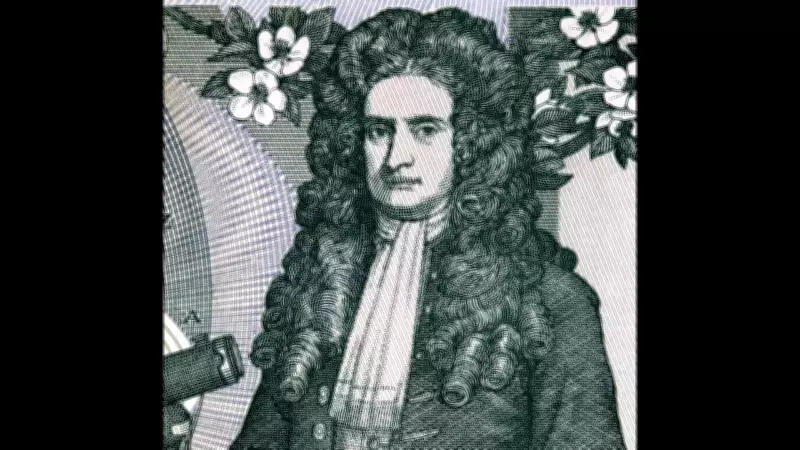
Isaac Newton: The Polymath Who Redefined Science and Philosophy
Isaac Newton, an English polymath, made groundbreaking contributions across mathematics, physics, astronomy, alchemy, theology, writing, and invention. His revolutionary work fundamentally altered humanity's understanding of the universe, laying the foundation for classical physics. Newton meticulously observed nature, employing mathematics and logic to explain its phenomena long before the advent of space telescopes and modern laboratories.
The Law of Universal Gravitation and Its Implications
From Newton's insights, people learned why objects fall to the ground, why planets follow predictable paths, and how forces transform matter. He formulated the law of universal gravitation, which accurately describes the motions of planets, moons, and celestial bodies around the Sun. This law enabled scientists to make precise predictions about planetary movements, showcasing the power of scientific inquiry.
The Limits of Scientific Explanation
Despite his brilliance, Newton acknowledged that science has inherent limitations. He famously stated, "Gravity explains the motions of the planets, but it cannot explain who sets the planets in motion." This quote underscores a crucial distinction: science excels at explaining how things work but often falls short in addressing why they exist or their ultimate origins. Newton believed that while understanding natural laws is vital, they do not answer all existential questions, reflecting the intertwined nature of astronomy, physics, philosophy, and theology in his era.

Relevance of Newton's Quote in Modern Times
Today, this quote remains widely shared because it promotes humility and continuous discovery. It reminds us that knowledge and explanation, though powerful, do not extinguish curiosity. Even with clear scientific answers, we are encouraged to wonder, reflect, and ask deeper questions. Newton's words highlight that learning is a perpetual journey, and recognizing our unknowns is a form of wisdom.
Applying Newton's Insights to Daily Life
In practical terms, this quote can guide everyday situations:
- Many life challenges can be logically analyzed, such as understanding system operations or cause-and-effect relationships.
- However, not all reasons, purposes, or motivations are fully explicable, urging patience and open-mindedness.
- It advocates for balancing logical learning with acceptance of uncertainties, fostering respect for knowledge while acknowledging its boundaries.
Other Notable Quotes by Isaac Newton
Newton's other sayings offer further wisdom for contemporary life:
- "If I have seen further it is by standing on the shoulders of giants." – Emphasizes learning from others' experiences to advance personally and professionally.
- "What we know is a drop, what we don’t know is an ocean." – Encourages humility and sustained curiosity in the face of vast unknowns.
- "I can calculate the motion of heavenly bodies, but not the madness of people." – Reminds us to be patient and realistic in human interactions, as behavior is not always predictable.
- "Truth is ever to be found in simplicity." – Advocates for clear, straightforward thinking in decision-making and communication.
Newton's legacy endures because his ideas resonate with timeless themes of curiosity, humility, and the pursuit of knowledge. His work continues to inspire scientists and thinkers to explore both the mechanics of the universe and the profound questions that lie beyond empirical explanation.