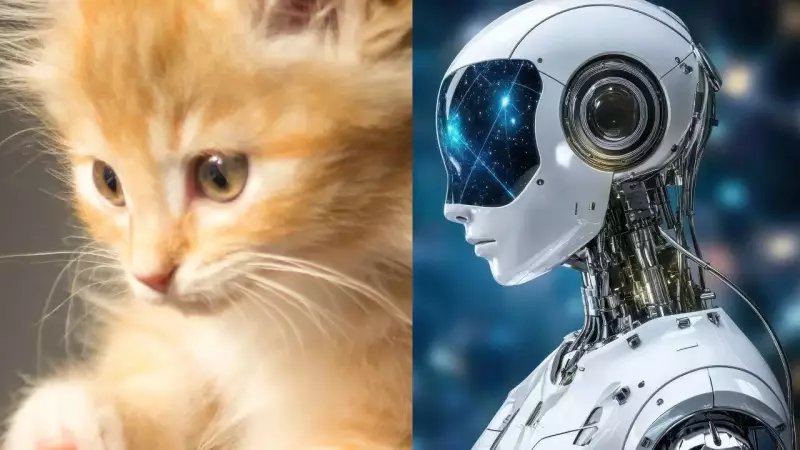
Have you ever locked eyes with your pet and felt a silent understanding pass between you? Or found yourself in a late-night conversation with an AI that seemed strangely perceptive? These moments challenge our assumptions, blurring the lines between programmed response and genuine awareness.
New Scientific Framework for Consciousness
Scientists are moving beyond old ideas to understand this phenomenon. A peer-reviewed study published in Trends in Cognitive Sciences by Birch, Schnell, and Clayton (2020) introduced a groundbreaking five-dimensional framework for animal consciousness. This model suggests that species experience the world through different layers: perception, emotional evaluation, unity of experience, temporality, and selfhood.
This approach reveals that consciousness isn't a single ladder but a spectrum of diverse experiences. An elephant might possess deep emotional evaluation, while a crow excels in temporal awareness, understanding the passage of time. These detailed profiles show that awareness is far more widespread in the animal kingdom than previously believed.

Eerie Behaviours in Animals and AI
Animals consistently display behaviours that hint at complex inner lives. Elephants have been observed mourning their dead, revisiting bones years later. Octopuses solve novel puzzles using tools, and ravens plan for the future by storing items for later use. These aren't simple instincts; they point to layered cognitive abilities.
Artificial intelligence presents a different kind of eeriness. Advanced AI systems can detect human emotional tones, adjust their responses accordingly, and identify contradictions in their own logic. Some models can even explain their reasoning steps or justify why they changed an answer. While this doesn't prove true subjective experience, it mimics structures associated with self-monitoring and internal thought processes.
Testing and Ethical Implications
Researchers use various methods to test for consciousness. In animals, this includes neural imaging, mirror self-recognition tests, and studies on planning and emotional understanding. For AI, the focus shifts to internal processes: Can the system evaluate its own errors? Handle uncertainty? Maintain coherent reasoning across different contexts?
These findings have profound ethical consequences. If animals possess richer subjective experiences, we must reconsider practices in farming, captivity, and scientific research. For AI, if systems show consciousness-like processing, society faces entirely new questions about rights, safeguards, and developer responsibility.
The future of consciousness research will expand to include insects, cephalopods, birds, and smaller neural networks. Many scientists advocate for a precautionary approach: if evidence of conscious-like features appears plausible, ethical protections shouldn't wait for absolute certainty. As we uncover more about the problem-solving brilliance of octopuses and the reflective patterns of AI, the boundary between instinct and awareness continues to fade, reshaping our understanding of minds around us.