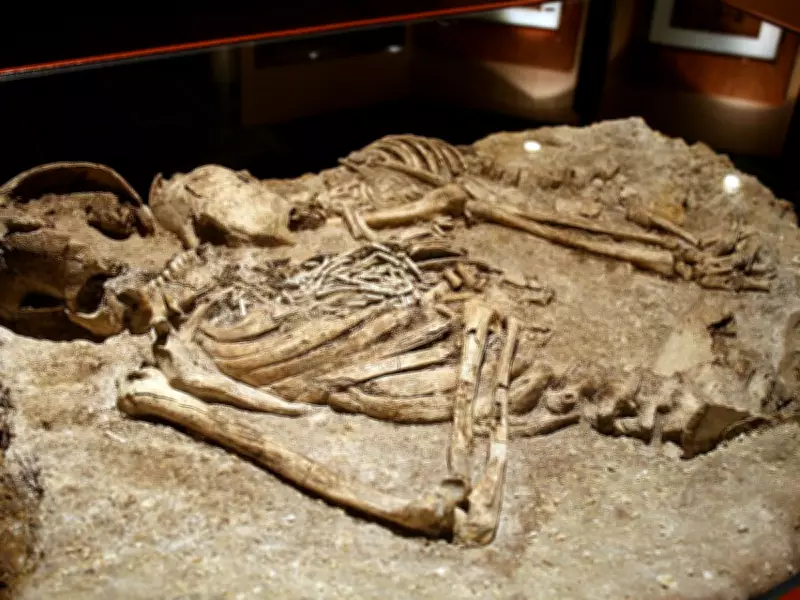
Scientists have gained an unprecedented glimpse into Neolithic social life by reconstructing a giant family tree spanning seven generations from a prehistoric cemetery in northern France. Using ancient DNA and archaeological evidence, experts mapped a detailed family network of 64 people who lived nearly 7,000 years ago at the Neolithic site of Gurgy “les Noisats.” This discovery transforms how specialists understand prehistoric cemeteries—not merely as burial grounds but as complex archives of human relationships, movement, and community rules.
DNA Reveals What Is Invisible
For Stone Age archaeologists, a persistent challenge has been understanding social ties from bones and grave goods, which reveal diet and tools but rarely kinship. However, the opportunity to sample nearly an entire burial population opened a new window into Gurgy. Researchers analyzed genome-wide ancient DNA from 94 individuals buried at the site, as detailed in a 2023 study published in Nature. By integrating genetic data with age, sex, and chemical signatures from teeth, they constructed two separate family trees. The larger pedigree connected 64 individuals across seven generations, making it the largest ancient family network ever reconstructed from a single cemetery at the time of publication.
This scale is highly significant. “Sampling of a near complete burial population provides a much stronger basis for archaeologists to interpret prehistoric life,” states a research briefing in the same journal. Rather than speculating about relationships based on body proximity or grave goods, DNA provided an accurate map of kinship that had remained invisible for millennia.

Stone Age Marriage Patterns
The genetic relationships revealed more than just biological ties; they offered surprising insights into household organization and marriage practices. The family tree points directly to a practice called patrilocality, where men remained in their birth communities after marriage while women left their families to join their husbands. Soil evidence indicates that the cemetery was anchored by a line of men who lived near home for generations. In contrast, many adult women buried at Gurgy appear to have migrated from outside the local community. This social structure allowed the family tree to grow extensively in one location, making the cemetery a record of ancient migration and residency patterns.
A Unique Community History Record
Gurgy’s findings align with a broader pattern across France, where Neolithic burial spaces were highly social and selective, governed by strict rules. At the Aven de la Boucle collective burial site in southern France, a close-knit family group used the site between 3600 and 2900 BCE, according to a study indexed in PubMed, with independent genomic and radiocarbon evidence converging. Another study from a Neolithic site in Normandy showed that access to burial sites was highly selective, often depending on specific lineages and male descent.
These cases support the idea that prehistoric communities viewed cemeteries as active historical archives. The dead were not buried randomly; rather, the privilege of burial in a family plot was determined by gender, lineage, and community status. Modern archaeology demonstrates that some of the clearest records of early human society were never written down. Instead, they were buried in the ground, waiting for modern science to read them.