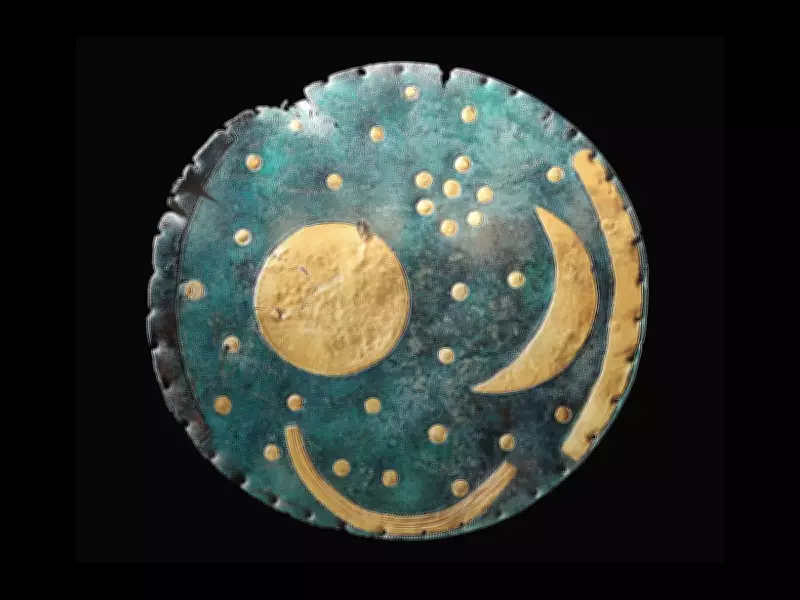
In 1999, a group of illegal metal detectorists unearthed a bronze disc near the Mittelberg hill in Saxony-Anhalt, Germany. The object was part of a hoard containing swords, axes, bracelets, and a chisel. However, it was the disc itself that turned historical debates entirely upside down. Its black surface was adorned with gold symbols, offering a condensed image of the heavens. This is why the Nebra Sky Disc remains a widely discussed Bronze Age artifact in Europe. Its story also highlights the damage looting can inflict on archaeological context. The illegal excavation caused significant harm to the find's contextual integrity. Later research treated the hoard as crucial evidence for Early Bronze Age life and craftsmanship around 1600 BCE. This tension between damage and insight lies at the heart of the disc's enduring appeal.
A Discovery That Entered Archaeology via Looting
The Nebra Sky Disc was not the result of a professionally controlled dig. It was discovered when looters stumbled upon it within a larger stockpile of weapons, tools, and ornaments. The illegal digging was detrimental because archaeological significance depends on context, not just the object itself. Looting removes the layers of dirt and evidence that allow experts to date a find and understand how it may have been used by people. Despite this inauspicious beginning, the Nebra hoard proved immensely valuable for historians. Later studies successfully identified the hoard as belonging to the Early Bronze Age, dating it to around 1600 BCE, according to a study published in the journal Nature. The disc was not a unique curiosity; it was tied to other objects that helped anchor it to a real Bronze Age burial assemblage. It is a story of theft and loss but also of survival and careful scientific recreation.
Gold Symbols: Why They Mattered in the Debate
The gold inlays on the bronze surface are thought to depict celestial shapes. The visual design was simultaneously simple and strange, providing a portable view of the sky as it appeared thousands of years ago. This imagery led scholars to consider whether prehistoric Europe may have been capable of more than simply observing the heavens. The term sky-literate has been used to describe the disc, suggesting careful observation rather than casual decoration. Its symbols were not generally regarded as accidental appendages or haphazard ornamentation. Instead, the object expanded the discussion from whether Bronze Age people looked to the sky to how meticulously they recorded what they saw. This led some scholars to treat the disc as an important test case for prehistoric astronomy.

How the Disc Was Made
For many years, the method of the disc's fabrication remained unclear. A new metallurgical study in 2024 shed fresh light on the physical creation of the artifact. Researchers reported in Scientific Reports that the disc was not simply hammered from a sheet but began as a cast preform and was repeatedly forged and annealed. This was a technically difficult process, requiring the ancient metalsmith to control shape, heat, and the behavior of the metal. Such work was not customary for a Bronze Age object. It points to highly specialized skills and a workshop culture capable of sustained, precise metalworking.
A Very Skilled Thing from the Bronze Age
The Nebra Disc's size, thinness, and complex manufacturing process make it unusual. In 2024, researchers compared the artifact to modern replicas to better understand the hammering and annealing cycles. Those comparisons demonstrated the considerable effort required to shape the disc without destroying it. Here, the story transitions from mystery to historical substance. The visual power of the disc is obvious, but its manufacture is equally telling. This level of skill suggests communities that may have supported specialized metalworking and staged production. It indicates that Bronze Age makers could combine practical metalworking and symbolic design in a single object.

What the Hoard Still Has to Say
The accompanying swords, axes, bracelets, and chisel help place the find in a wider Bronze Age context. This broader context makes the disc more than a solitary treasure. It was found with objects referencing status, craft, and everyday use, indicating a world where metal held social and symbolic value. Ultimately, the disc did not prove that Bronze Age people had modern astronomy. What it proved is that they could create complex objects, revise them over time, and encode ideas about the sky in bronze and gold. The Bronze Age record in Europe is now better understood. It was, in the most literal sense, sky-literate.