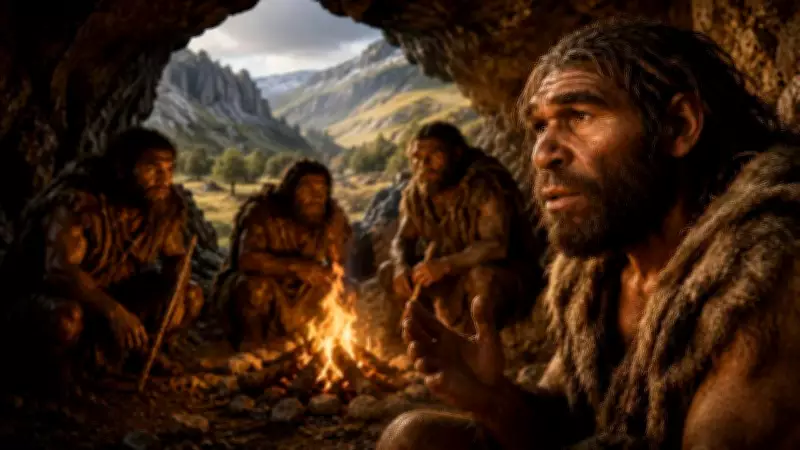
For decades, Neanderthals were thought to be our less sophisticated cousins who communicated through basic sounds and simple gestures. Yet, a fresh scientific review is shaking up this notion, arguing that Neanderthals might have had a language almost as complex as our own. Researchers analyzing genetic, archaeological, and fossil evidence suggest that the origins of spoken language trace back hundreds of thousands of years, well before Homo sapiens appeared. If true, this forces a reevaluation of human evolution and raises the question: did we ever truly have language all to ourselves?
Neanderthals Show Signs of Advanced Coordination and Environmental Adaptation
For much of modern science history, Neanderthals were portrayed as simple, limited beings. That view is now steadily collapsing. Archaeological discoveries reveal they hunted in organized groups, used tools with precision, and survived harsh Ice Age climates across Europe and western Asia for hundreds of thousands of years.
According to researchers, these abilities would have been difficult without some form of structured communication. The idea that they relied only on basic sounds is increasingly seen as too narrow, especially given their long survival through shifting environments that demanded coordination and planning.

How Ancient Human Ancestors May Have Developed Early Language Skills
The major shift in thinking comes from the timeline itself. One influential review suggests that the foundations of language could stretch back around 500,000 years to the last common ancestor shared by modern humans, Neanderthals, and Denisovans, as reported in the study published in Frontiers, titled ‘On the antiquity of language: the reinterpretation of Neandertal linguistic capacities and its consequences’.
Some researchers even go further, proposing that early forms of language may have emerged nearly a million years ago in gradual stages, rather than appearing suddenly in a “modern human leap” around 50,000 years ago. Genetic research has already confirmed that modern humans interbred with Neanderthals after leaving Africa. That exchange left traces in our DNA that are still visible today in non-African populations.
Ancient DNA Findings Renew Debate on Neanderthal Communication Abilities
Scientists now suggest those encounters may have involved more than just genes. If groups met, interacted, and possibly shared knowledge, then communication would have been essential. Some researchers argue this opens the possibility that linguistic influences were exchanged too, although direct evidence of Neanderthal speech still does not exist.
It remains a hypothesis, but one that is becoming harder to dismiss as more data emerges from ancient DNA and improved fossil analysis.