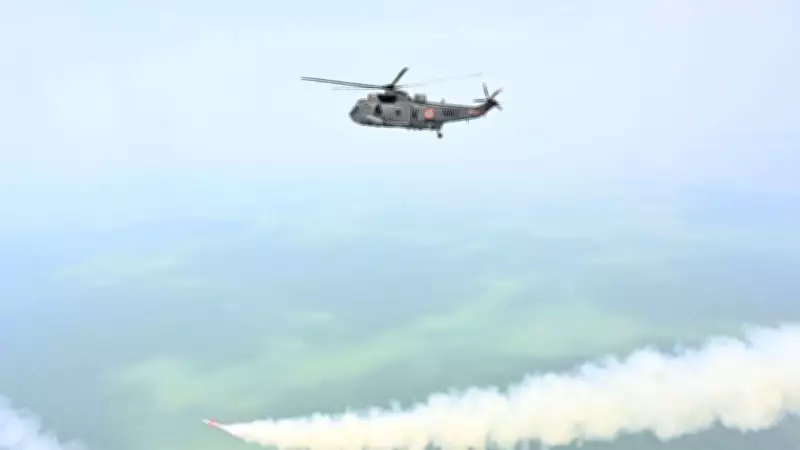
The Indian Navy and the Defence Research and Development Organisation (DRDO) have achieved a significant milestone by successfully executing the first salvo firing of the Naval Anti-Ship Missile–Short Range (NASM-SR). This test was conducted from a Sea King helicopter operating off the coast of Odisha in the Bay of Bengal.
Salvo launch capability demonstrated
During the trial, the helicopter launched two NASM-SR missiles in rapid succession, showcasing the system's ability to perform a salvo launch. This capability is crucial as it overwhelms a target vessel's defensive systems by presenting multiple incoming threats simultaneously, thereby reducing the ship's chances of effective countermeasures.
Test objectives fully met
All objectives of the NASM-SR salvo launch test were successfully achieved, as confirmed by telemetry data collected from tracking instruments. The data was recorded using radar and electro-optical systems deployed at the Integrated Test Range. The missiles demonstrated their precision in striking at the waterline of the target, a critical vulnerability point where a ship is most susceptible to flooding and sinking.

Witnessed by key stakeholders
The test was observed by representatives from the Indian Navy and Air Force, along with scientists from DRDO and Adani Aerospace & Defence, which serves as the Development-cum-Production Partner (DcPP) for the missile system.
Features of NASM-SR
The NASM-SR is a fire-and-forget missile, meaning that once it locks onto a target and is launched, it can guide itself autonomously without further input from the launch platform. It also possesses the capability to lock onto a target after launch. The missile carries a 100 kg warhead and has a range of 55 km. It is designed to fly at very low altitudes over the sea at high subsonic speeds, which delays detection by enemy warships and reduces their reaction time.
One of the key features of the NASM-SR is its long-burn sustainer, which allows it to remain powered for a longer duration compared to similar systems that spend more time in the glide phase. This enhances its maneuverability and reduces its vulnerability to interception.
Indigenous development
Critical subsystems of the missile, including the seeker, navigation, guidance, avionics data link with the launch platform, and jet vane control, have been developed indigenously by DRDO in collaboration with domestic industry partners.
Future developments
The DRDO and the Navy are also advancing a more powerful and longer-range variant known as the Naval Anti-Ship Missile–Medium Range (NASM-MR). This system was prominently showcased on the Navy's MiG-29K fighter jet during Aero India 2025, indicating its integration with naval aviation platforms.