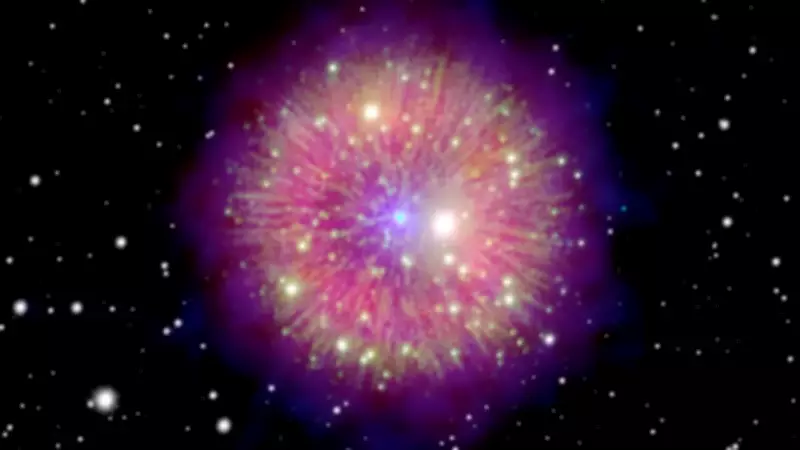
NASA's Chandra X-ray Observatory Unlocks Ancient Cosmic Mystery
For over 1,800 years, the celestial event known as the 'guest star' of 185 AD has baffled astronomers worldwide. Ancient Chinese chroniclers meticulously documented a mysterious light that persisted in the night sky for eight months before vanishing, leaving behind one of history's most enduring astronomical enigmas.
The Puzzling Supernova Remnant
When modern telescopes eventually identified the remnant of this cosmic event as RCW 86, scientists encountered a perplexing contradiction. The debris field measured an astonishing 85 light-years across, suggesting an age of approximately 10,000 years rather than the expected 2,000 years since the recorded explosion.
This size discrepancy created what researchers called a "cold case" of cosmic proportions, with the physical evidence seemingly contradicting historical records until NASA's advanced observational capabilities provided the breakthrough.

The Hidden Bubble Revelation
New research utilizing NASA's Chandra X-ray Observatory has finally unveiled the truth behind this ancient mystery. The key discovery reveals that the star exploded within a previously undetected low-density 'hidden bubble' created by the star's own stellar winds before its demise.
"This represents a fundamental shift in our understanding of this historical event," explained astronomers involved in the study. "The star essentially cleared its own path before the final explosion."
Mechanics of the Rapid Expansion
The pre-explosion stellar winds acted as a cosmic leaf blower, pushing away surrounding gas and dust to create an expansive bubble of low-density space. When the supernova eventually occurred, the ejected material encountered virtually no resistance, allowing it to travel at speeds exceeding 10 million kilometers per hour.
This unprecedented velocity explains how the debris field expanded to such enormous dimensions in just two millennia, solving the long-standing mystery of RCW 86's apparent age discrepancy.
The Cosmic Rebound Effect
Perhaps the most fascinating aspect of this discovery involves what researchers term the 'bounce back' effect. As the rapidly expanding material finally reached the edge of the hidden bubble where gas density increased significantly, it created a reverse shock wave that pushed back toward the explosion's center.
This rebound phenomenon heated the previously cold gas within the bubble to temperatures of several million degrees, causing it to emit X-rays detectable by Chandra's sensitive instruments.
- The reverse shock wave created secondary heating effects
- X-ray emissions revealed the bubble's previously hidden structure
- This mechanism explains how astronomers finally detected the low-density environment
Historical Significance Confirmed
With this new understanding, astronomers can now definitively identify the 185 AD event as humanity's first recorded observation of a supernova. The Chinese astronomers who meticulously documented the eight-month phenomenon were witnessing what we now recognize as a Type Ia supernova occurring under unique environmental conditions.
Broader Implications for Cosmology
This discovery extends far beyond solving a single historical mystery. Type Ia supernovae serve as crucial 'standard candles' for measuring cosmic distances and studying the universe's expansion. By understanding how environmental factors like the hidden bubble affect supernova characteristics, astronomers can improve their calibration of these cosmic measuring tools.
- Improved distance measurements to distant galaxies
- Better understanding of dark energy's effects on universal expansion
- Enhanced models for supernova behavior in varied environments
The resolution of this 2,000-year-old mystery demonstrates how ancient astronomical records combined with modern technology can yield profound insights into cosmic mechanics, potentially advancing our understanding of fundamental forces shaping the universe.