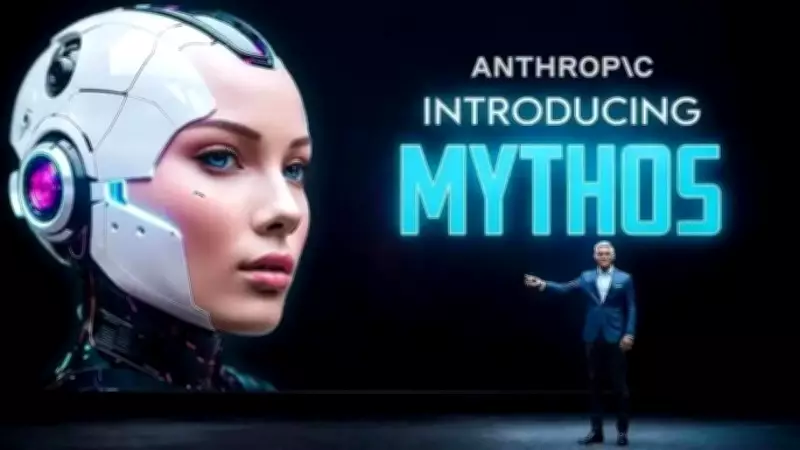
Anthropic's Mythos AI Model Signals Major Shift for IT Industry, Warns Kotak Securities
Bengaluru: In a development with potentially seismic implications for the technology sector, Anthropic's new Mythos artificial intelligence model represents a clear departure from the gradual, incremental improvements typically observed across successive frontier AI systems. The breakthrough is particularly pronounced in software engineering tasks, where Mythos demonstrates a sharp, non-linear jump in benchmark performance that diverges markedly from recent trends of moderate progress.
Kotak Securities Revises IT Growth Projections Amid AI Advancements
Financial analysts at Kotak Securities have issued a stark warning in a recent research note. The firm suggests that if the capabilities demonstrated by Mythos translate effectively into real-world enterprise deployments, earlier estimates of a 3–3.5% annual growth headwind for the IT services industry over the next three years could shift from a cautious projection to a more realistic baseline scenario. The note further cautions about escalating downside risks should future frontier models continue to deliver similar step-change improvements in capability.
"The model appears to significantly advance agentic software development capabilities based on qualitative assessments," the Kotak analysis states. However, it tempers this observation with a crucial caveat: the real-world impact remains uncertain as Mythos's capabilities are yet to be proven at scale, owing to the absence of a public release. The report specifically highlights that disruption risks could be disproportionately higher for IT services firms with greater exposure to application development and maintenance services.

Disruption Extends Beyond Traditional IT to Engineering Services
Industry experts suggest the ripple effects of such AI advancements could extend far beyond conventional IT services. Viral Shah, co-founder and CEO of JuliaHub, warns that even specialized engineering services firms focused on hardware design, testing, and verification for critical industries like aerospace, automotive, and semiconductors could face significant disruption.
"Anything that is digital is fair game," Shah asserts. "AI represents a fundamental economic shift from labor to capital." He describes the short-term impact as likely manifesting in margin pressures, while the long-term consequences could be existential for some companies. "I expect a bimodal distribution where a few firms adapt and go from strength to strength while others may vanish entirely," he adds, characterizing Mythos as a major advancement that has already identified previously undetected security vulnerabilities in highly secure operating systems.
Structural Shift in Service Delivery and Emerging Opportunities
Not all perspectives paint a purely negative picture. Some industry leaders see a transformation in demand rather than an outright decline. Namratha Dharshan, chief business leader at ISG, observes that revenue deflation has already occurred in routine, repetitive, and low-value work. However, she emphasizes that AI-driven disruption is simultaneously creating substantial new opportunities in adjacent areas.
"We are already witnessing a 20% year-on-year increase in new scope of work as companies pivot to segments like system integrations, data readiness, governance frameworks, cybersecurity enhancements, and sophisticated workflow design," Dharshan notes. She concludes that the traditional model of labor arbitrage is no longer sustainable for the future.
Forrester Analyst Details the Changing Service Bottleneck
Biswajeet Mahapatra, principal analyst at Forrester, provides a granular view of the impending structural shift. He identifies services built around repetitive defect discovery, regression testing, and low-complexity application maintenance as the most vulnerable. Models like Mythos can dramatically compress the effort required to identify bugs, security flaws, and logic errors, especially in code-intensive environments.

However, Mahapatra does not anticipate a wholesale collapse in industry revenue. Instead, he predicts the bottleneck will migrate. "The challenge will shift from mere detection to more complex functions like triage, remediation prioritization, coordinated patching, and safe deployment," he explains. These areas still demand deep system context, rigorous governance, and clear accountability—domains where human expertise remains crucial.
The analyst delineates a clear divergence in corporate futures: firms clinging to manual testing models face heightened risks, while those proactively pivoting toward secure-by-design engineering principles, remediation orchestration platforms, and AI-augmented reliability services are likely to see demand evolve in their favor rather than disappear.