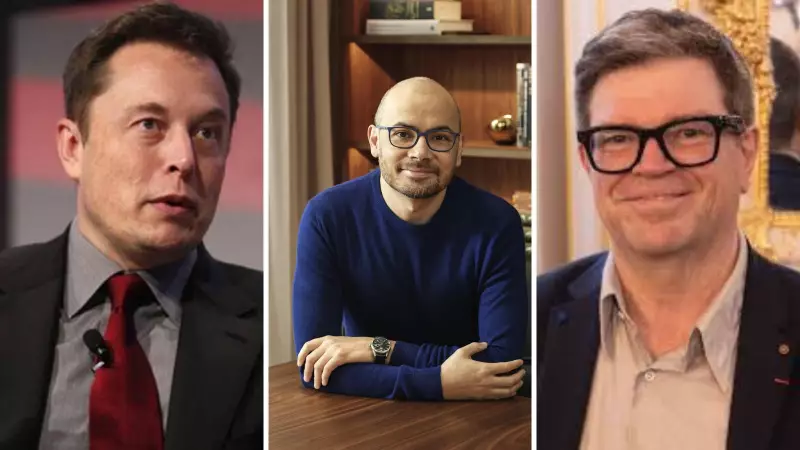
A major public disagreement between two of the world's leading artificial intelligence experts has reignited the global debate on the future and feasibility of Artificial General Intelligence (AGI). The clash involves Google DeepMind CEO Demis Hassabis and NYU professor and former Meta AI head Yann LeCun, a Turing Award winner often called a godfather of AI. The dispute has now drawn in tech billionaire Elon Musk, who has publicly taken sides.
The Core of the Disagreement: Is AGI an Illusion?
The controversy began after Yann LeCun expressed his views on a podcast. He argued that the very concept of general intelligence is fundamentally flawed. LeCun stated that human intelligence is not truly general but is instead specialized for interacting with the physical world. He described the common perception of AGI as an "illusion", pointing out that while humans appear versatile, our intelligence has clear limits and cannot solve every problem we encounter.
Demis Hassabis was quick to counter this viewpoint. The Google DeepMind chief stated that LeCun was "plain incorrect" and was confusing general intelligence with universal intelligence. Hassabis elaborated that a general system, in the theoretical sense of a Turing Machine, is capable of learning anything computable given sufficient resources like time, memory, and data. He posited that both the human brain and modern AI foundation models act as approximate Turing Machines.

Elon Musk Weighs In, Backing Hassabis
The exchange between the AI pioneers did not go unnoticed. Elon Musk, the founder of xAI and a prominent figure in the AI space, reshared Hassabis's arguments on his social media platform. Musk explicitly endorsed the Google DeepMind CEO's position, simply stating, "Hassabis is right." This endorsement from one of the world's most influential tech leaders has amplified the debate, bringing it to a much wider audience.
The heart of the debate lies in the definition and possibility of AGI. AGI refers to a hypothetical AI that possesses the ability to understand, learn, and apply its intelligence to solve any problem that a human being can. It would be capable of:
- Adapting to entirely new and unfamiliar situations.
- Improvising solutions in real-time.
- Going beyond patterns learned from its initial training data.
LeCun argues that today's AI systems, including advanced chatbots like ChatGPT and Google's Gemini, are nowhere near this level. Despite their ability to handle complex tasks and pass difficult exams, he maintains they lack true human-level understanding, flexibility, and real-world adaptability.
Why This Debate Matters for India's Tech Future
This academic and philosophical debate has significant practical implications. As India rapidly adopts AI across sectors like healthcare, education, finance, and governance, the direction of AI research shapes the tools the country will use. The question of whether to aim for narrow, task-specific AI or to invest in the longer-term pursuit of more general systems influences policy, investment, and education.
The public sparring between Hassabis and LeCun, now highlighted by Musk's involvement, underscores a critical fork in the road for global AI development. It forces the tech community to re-examine its foundational goals. Whether AGI is a tangible target or a misleading mirage will determine the trajectory of research for years to come.
The debate, which gained public attention on December 26, 2025, shows that even as AI technology advances at a breakneck pace, its ultimate destination remains a hotly contested topic among its foremost architects.