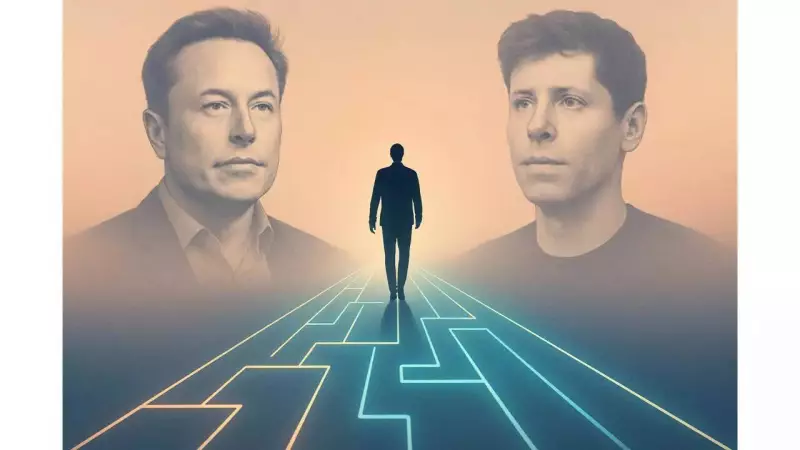
A resurfaced video has thrust Tesla CEO Elon Musk back into the center of the artificial intelligence debate, with the billionaire making a bold claim about his role in creating ChatGPT-maker OpenAI. The revelation sheds new light on the origins of the AI giant and highlights a fundamental philosophical clash with Google co-founder Larry Page.
The Founding Philosophy: A Reaction to Google
In the video, Elon Musk states unequivocally, "I am the reason OpenAI exists." He traces the company's genesis to deep, late-night conversations about AI safety with his then-close friend, Larry Page. Musk expressed constant concern about the potential dangers of advanced AI, while Page appeared "quite cavalier" about the risks.
Musk described the AI landscape at the time as a "unipolar world" dominated by Google, especially after its acquisition of DeepMind. Google controlled about three-quarters of the world's AI talent, along with vast computational resources and capital. This concentration of power in the hands of someone seemingly unconcerned with safety struck Musk as "a real problem."

The breaking point came when Larry Page labeled Musk a "speciest" for prioritizing human consciousness over machine consciousness. Musk's response was, "Well, yes, I guess I am a speciest." This ideological rift was the catalyst for action. Musk co-founded OpenAI in 2015 alongside Sam Altman, Greg Brockman, and others, envisioning it as the antithesis of Google.
Open Source Ideals vs. For-Profit Reality
Elon Musk revealed that he personally came up with the name 'OpenAI,' signifying its founding principle: open source. The intent was to create an open-source, non-profit entity, directly opposing Google's closed-source, for-profit model, which Musk believed harbored a dangerous profit motivation.
He expressed profound disappointment with the company's subsequent evolution. Musk left the OpenAI board in 2018, citing disagreements over the company's direction and control. In the video, he questions the legality and ethics of OpenAI's transformation from a non-profit to a for-profit, closed-source company.
"It does seem weird that something can be a nonprofit, open source, and somehow transform itself into a for-profit, closed source," Musk remarked. He offered a stark analogy: founding an organization to save the Amazon rainforest, only to see it become a lumber company that chops down the forest for profit. "That's the exact opposite of what I gave the money for," he emphasized, questioning the legality of such a fundamental shift in mission.
Raising Alarms on Control and Microsoft's Role
Beyond the philosophical betrayal, Musk voiced serious concerns about the balance of power and ultimate control over OpenAI's potentially world-altering technology. He pointedly asked who would be in control if OpenAI creates a "digital super intelligence, almost Godlike intelligence."
Musk directed specific scrutiny at the relationship between OpenAI and its major investor, Microsoft. "I do worry that Microsoft actually may be more in control than the leadership team at OpenAI realizes," he cautioned. He highlighted that Microsoft's investment agreement grants it rights to all software, model weights, and everything necessary to run the AI inference systems.
This arrangement, according to Musk, means "At any point, Microsoft could cut off OpenAI," suggesting a precarious dependency that could contradict the organization's original mission of broadly beneficial AI. His comments underscore ongoing debates about corporate influence in the development of powerful and potentially autonomous AI systems.
The resurfacing of these comments adds a new layer to the public understanding of OpenAI's controversial journey. It frames the company not just as a tech success story, but as an entity born from a safety crusade, now navigating the complex tensions between its founding ideals, commercial pressures, and the immense power of its creations.