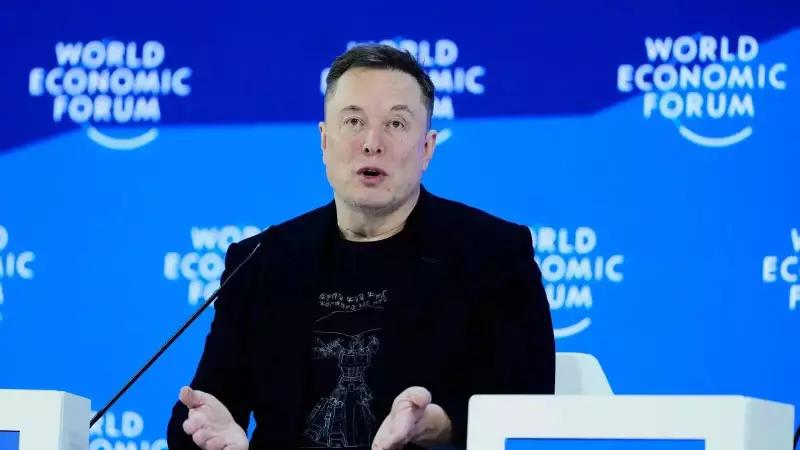
Elon Musk Makes Historic Davos Debut with Bold Predictions on Aging and Robotics
In a landmark moment at the World Economic Forum in Davos, Switzerland, Tesla and SpaceX CEO Elon Musk took the global stage for the very first time, delivering provocative insights on human longevity, artificial intelligence, and the future of robotics. The billionaire entrepreneur, who has previously criticized the forum as a gathering of out-of-touch elites, participated in a high-profile discussion that captured international attention.
Reversing the Biological Clock: A Solvable Challenge
During his conversation with BlackRock CEO Larry Fink, Musk made a striking declaration about one of humanity's oldest challenges. "Aging is a very solvable problem," he asserted, suggesting that science may soon unlock the secrets to reversing the biological aging process. Musk elaborated on his vision, stating that when researchers identify the root causes of aging, the solution will appear remarkably straightforward.
"All the cells in your body age at the same rate," Musk observed. "I've never seen someone with an old left arm and a young right arm." This uniform aging pattern led him to speculate about a master biological clock that synchronizes the aging process across the body's approximately 35 trillion cells—a mechanism he believes science will decode in the near future.

The Philosophical Dimension of Mortality
Despite his technological optimism, Musk introduced a thoughtful caveat about the potential societal implications of dramatically extended lifespans. He acknowledged that death serves an important purpose in human civilization, warning that excessive longevity could lead to societal stagnation.
"There is some benefit to death," Musk reflected. "If people live for a very long time, there's a risk of ossification of things getting locked in place. It may become stultifying. A lack of vibrancy." This nuanced perspective highlighted his consideration of both technological possibilities and their broader human consequences.
Humanoid Robots and Advanced AI on the Horizon
Beyond discussions of aging, Musk unveiled ambitious timelines for Tesla's robotics division. He announced that the company expects to begin selling humanoid robots to the general public by the end of 2025, a slight adjustment from earlier projections. These Optimus robots, he suggested, could revolutionize daily life by performing various domestic and caregiving tasks.
"Who wouldn't want a robot to watch over your kids, take care of your pet... If you had a robot that could take care and protect an elderly parent, that'd be great," Musk told the captivated Davos audience. He added that the robots would undertake more complex functions later this year, paving the way for commercial availability.
Musk also made a bold prediction about artificial intelligence development, forecasting that AI models would surpass human intelligence "by the end of this year, and I would say no later than next year." This statement adds to his ongoing commentary about both the promise and perils of advanced artificial intelligence.
A Surprising Appearance with Personal Endorsement
The session marked a notable departure for Musk, who has historically been critical of the World Economic Forum. Interviewer Larry Fink offered a personal introduction that countered common perceptions of the controversial entrepreneur.
"There are so many myths around Elon Musk," Fink remarked. "I could tell you he is a great friend, and I constantly learn so much from him. I am totally inspired by what he has done... Who he is... His vision of the future, and I don't think it's such a bad future."
This endorsement from one of the world's most influential financial leaders provided a unique framing for Musk's wide-ranging discussion, which touched on everything from cellular biology to futuristic robotics. The appearance demonstrated Musk's continued willingness to engage with global institutions while maintaining his characteristic visionary—and sometimes controversial—perspective on humanity's technological trajectory.