Astronomers Redefine Understanding of Common Exoplanets
For over a decade, astronomers have been meticulously cataloging thousands of planets beyond our solar system, with many falling into a peculiar intermediate category. These worlds, known as sub-Neptunes, are larger than Earth but smaller than Neptune, and they appear to be ubiquitous in the cosmos wherever modern telescopes gaze. From a distance, these exoplanets seemed promising, with their sizes and atmospheres fueling speculation about vast oceans hidden beneath thick layers of gas. However, groundbreaking new research suggests this optimistic picture may be fundamentally misleading.
From Ocean Worlds to Molten Realms
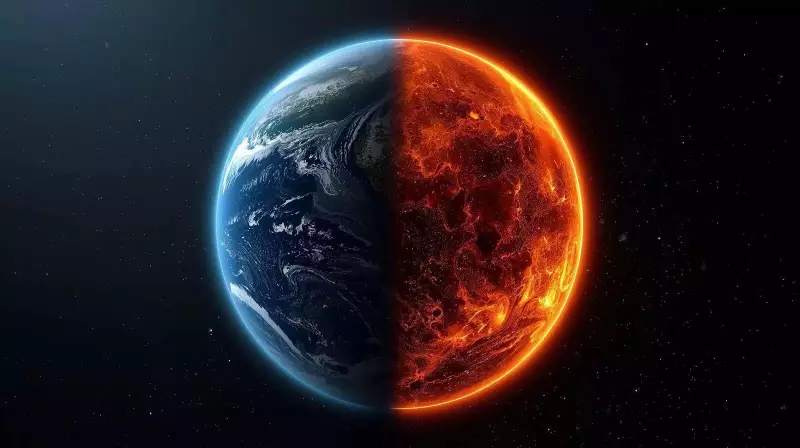
Instead of calm, water-rich environments, most sub-Neptune planets may actually be intensely hot worlds dominated by molten rock interiors. This paradigm shift doesn't stem from new observations but from a novel approach to interpreting existing astronomical data. Worlds once believed to harbor deep oceans are now suspected to be lava-dominated spheres, challenging previous assumptions about their potential habitability.
The Challenge of Planetary Degeneracy
Sub-Neptunes represent the most common type of exoplanet detected to date, yet they remain poorly understood by scientists. Current measurements typically provide researchers with only a planet's radius and mass, creating significant ambiguity. From these limited data points, multiple internal structures can fit the same information—a planet might have a deep ocean beneath a hydrogen atmosphere or a rocky interior enveloped in gas, with both scenarios appearing identical from Earth's perspective. This scientific uncertainty, known as degeneracy, has profoundly shaped debates about potentially habitable worlds beyond our solar system.

The Gas Dwarf Hypothesis
One longstanding theory proposes that many sub-Neptunes are actually gas dwarfs. According to this model, these planets feature Earth-like cores composed of silicates and iron, surrounded by thick hydrogen-dominated atmospheres. These worlds would have formed under extremely hot conditions, raising the crucial question of whether they have cooled sufficiently over time to solidify internally. This distinction matters profoundly because solid and molten planets behave very differently, particularly regarding their atmospheric characteristics and potential for supporting life.
How Molten Interiors Transform Atmospheres
When a planet hosts a global magma ocean, the molten rock doesn't remain isolated—it actively interacts with the atmosphere above it, absorbing and releasing various gases. This dynamic process can significantly affect chemical markers such as methane, carbon dioxide, and ammonia. Previous studies interpreted the absence of ammonia in some exoplanet atmospheres as evidence of liquid water, since water efficiently absorbs ammonia. However, the new research demonstrates that molten rock produces remarkably similar atmospheric signatures, meaning the same atmospheric signal could originate from either a water world or a lava-dominated planet.
The Solidification Shoreline Concept
To explore this phenomenon further, researchers introduced an innovative concept called the solidification shoreline. This framework connects the amount of energy a planet receives from its host star with the star's temperature. Using a sophisticated coupled interior and climate model known as PROTEUS, scientists simulated how long magma oceans might persist on these distant worlds. When known sub-Neptune exoplanets were plotted against this theoretical boundary, nearly all of them fell on the hot side of the line. Approximately 98 percent appear to receive sufficient stellar energy to remain molten even today, assuming they are indeed gas dwarfs.

Reevaluating Hycean Worlds
The research, titled "Most Rocky Sub-Neptunes are Molten: Mapping the Solidification Shoreline for Gas Dwarf Exoplanets," directly challenges the concept of hycean planets—worlds thought to host deep oceans beneath hydrogen-rich skies. A prominent example is K2-18b, previously described as a strong ocean candidate. While the new interpretation doesn't completely rule out the possibility of water on some sub-Neptunes, it suggests that molten interiors provide a more straightforward explanation based on fundamental physics rather than chemistry alone. Certain combinations of mantle composition and atmospheric carbon could potentially shorten magma ocean lifetimes, but such planets would likely not match the observed sizes of most sub-Neptunes.
Implications for Astrobiology and Future Research
For scientists searching for extraterrestrial life, these findings present sobering implications. Lava-dominated worlds are unlikely to provide hospitable environments for life as we know it. Nevertheless, this research establishes a clearer foundation for future studies, highlighting both the limitations of current atmospheric data and how easily optimistic interpretations can emerge. Rather than completely closing the door on ocean worlds, the study narrows the field of potential candidates. It suggests that many planets once imagined as water-rich may instead be realms of enduring heat, quietly reshaping how scientists conceptualize the most common planetary types in our galaxy.
About the Research Team
The TOI Science Desk represents a dedicated team of journalists committed to exploring scientific discoveries and presenting captivating news, features, and articles from the ever-evolving world of science. Serving as your scientific companion, they deliver daily insights into genetic engineering, space exploration, artificial intelligence, and beyond. More than mere reporters, they are storytellers of scientific narratives, demystifying complex concepts and making science accessible and engaging for readers across all backgrounds.