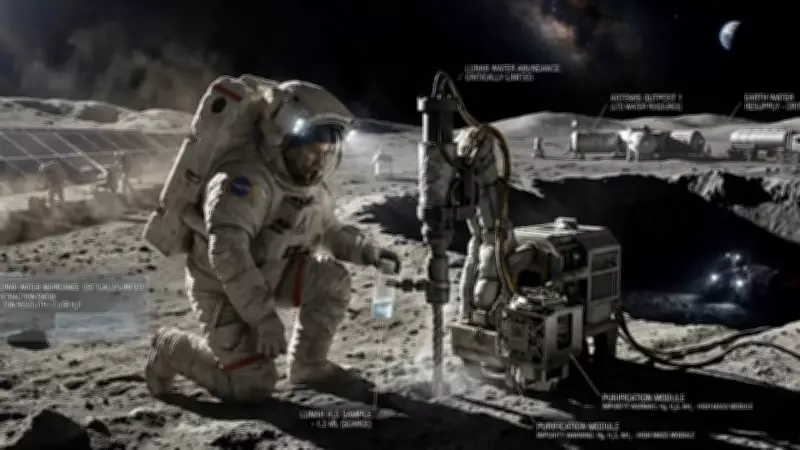
Lunar Water Discovery Falls Short for Future Space Exploration
The initial discovery of water on the Moon was hailed as a paradigm-shifting breakthrough, promising to revolutionize deep-space logistics and enable extended astronaut missions to the Moon and beyond. However, recent scientific data from agencies like NASA and the European Space Agency (ESA) present a sobering reality. While hydration is indeed present on the lunar surface, its concentration is strikingly low, scattered across the regolith in mere parts per million. Estimates indicate that lunar water is roughly two orders of magnitude drier than the Sahara Desert, challenging the feasibility of long-term settlement plans.
Vast Shortage of Water Molecules Hinders Harvesting Efforts
The primary obstacle for future missions aiming to colonize the Moon or launch to Mars is the sheer volume of soil required to extract usable water. Scientists at NASA's Moon Mineralogy Mapper estimate that it takes approximately 1 metric ton of lunar soil to produce just 1 liter of water. This makes large-scale harvesting extremely energy-intensive with current In-Situ Resource Utilization (ISRU) technologies. The process involves heating vast amounts of regolith to sublimate trace ice or break chemical bonds in minerals to release water, posing monumental logistical and engineering hurdles.
Engineering Challenges in Accessing Lunar Water
Although the South Pole of the Moon features cold traps with potentially higher water occurrence, these areas exist in perpetual darkness with temperatures plummeting to -230 degrees Celsius. Designing machinery capable of drilling into the cryogenic, rock-like regolith without seizing or tearing apart is a significant engineering challenge. Additionally, the ESA has determined that current prototypes struggle to precisely control pressure and temperature during the phase transition from sublimation in a vacuum to vapor, a critical sequence for effective water harvesting.

Impurities and Filtration Requirements Complicate Usage
Lunar water is not the pure ice found on Earth; it contains toxic impurities such as mercury, methane, ammonia, and hydrogen sulfide, as confirmed by data from the LCROSS mission. If future missions intend to use this water for human consumption or as rocket fuel, heavy and sophisticated purification systems must be transported to the Moon. This necessity could offset the advantages of in-situ resource utilization, adding further complexity to colonization efforts.
In summary, while the presence of water on the Moon offers a glimmer of hope for deep-space exploration, its scarcity, extraction difficulties, and impurity issues present formidable barriers. Addressing these challenges will require advanced technological innovations and strategic planning to make lunar colonization and Mars missions viable in the coming decades.