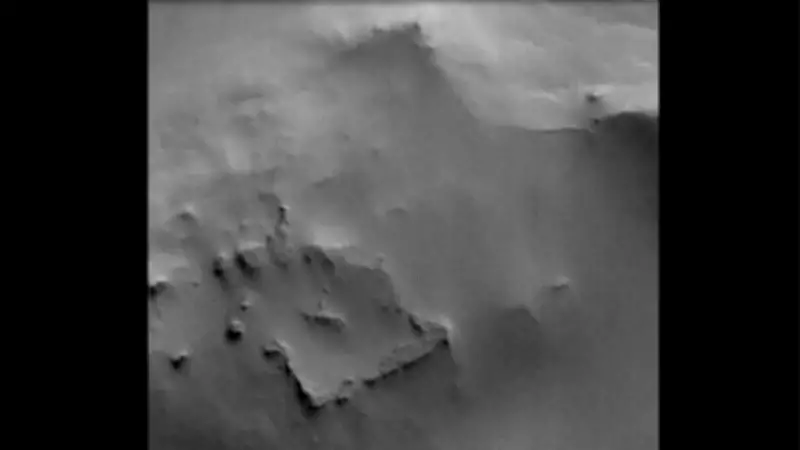
A strange square-like shape spotted on Mars has been circulating online once more, sparking fresh waves of curiosity. The image, originally captured by NASA's Mars Global Surveyor in 2001, appears to show a neat geometric form nestled inside a crater. Social media users quickly speculated about hidden ruins or signs of an ancient civilization, and the image spread rapidly. However, space scientists and geologists remain unconvinced by the excitement. Later missions have observed the same region with clearer imaging, revealing that the shape is likely a trick of angles, shadows, and natural rock formations rather than anything artificial. Mars has a tendency to play with human imagination in such ways.
What NASA Really Says About the So-Called Square Formation on Mars
The original image comes from an old NASA mission, now long retired. The Mars Global Surveyor operated in the late 1990s and early 2000s, mapping large portions of the Martian surface. In one of its frames, a section of a crater appears to have sharp edges that loosely resemble a square. The image resurfaced on various social media platforms, where users zoomed in, cropped sections, and highlighted the "perfect angles." Some posts went viral, with claims that the structure looked "engineered." A few public figures even reacted, adding fuel to the conversation. NASA scientists, however, point out a simple explanation: the image resolution is limited, and lighting plays a huge role. What appears sharp in one version becomes far less convincing when viewed in greater detail.
2025 Viral Image of a Square on Mars: What Higher-Resolution Images Revealed
Later observations from the Mars Reconnaissance Orbiter provide a clearer picture of the same area. The HiRISE camera, which is far more advanced, shows uneven terrain, small cliffs, and scattered mounds. A NASA spokesperson reportedly explained that what looks like a "corner" is actually a cliff edge shaped by the natural breakdown of terrain over time. Mars is full of such fractured landscapes. The surface constantly shifts through wind erosion and ancient geological stress. It is not unusual for random formations to appear structured from a distance. On Mars, this effect is amplified by low lighting angles and heavy shadow contrast. There is also a psychological angle at play. Experts often refer to a phenomenon called pareidolia—the tendency of the human brain to see familiar shapes in random patterns. Once the brain spots something like a "square," it tries to complete the picture, even when the physical evidence does not fully support it. This is how many famous Mars "discoveries" have gone viral in the past, including the well-known "Face on Mars," which later turned out to be just a naturally shaped hill.

How Volcanic Activity and Rock Fractures Form Geometric Patterns
One overlooked point is that geometry is not exclusive to human construction. Nature produces straight lines and sharp angles in many ways. Rock fractures can intersect at right angles. Volcanic activity can split terrain into grid-like patterns. Even dried mud and salt flats can form structured shapes over time. Earth has plenty of examples, such as the Giant's Causeway in Northern Ireland, which features hexagonal basalt columns formed through cooling lava. Similar processes could easily explain angular patterns on Mars. So the "square" is likely just a mix of fractured rock layers and erosion lines intersecting unusually, with nothing more structured underneath.