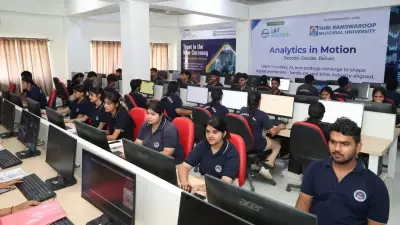
Lucknow Schools Grapple with Rising AI Use in Student Homework
In several educational institutions across Lucknow, teachers have observed a noticeable trend: essays that are impeccably written, answers that appear flawless, and homework submissions that are completed with unusual speed. What initially seemed like a positive shift toward greater academic discipline and focus has revealed a more complex reality—the quiet but steadily growing integration of Artificial Intelligence into students' schoolwork.
The AI Revolution in Classroom Assignments
With free AI-powered tools readily accessible online, students are increasingly turning to technology to draft essays, solve mathematical problems, and complete various assignments. This reliance on artificial intelligence has compelled schools in Lucknow to reevaluate and redesign their educational strategies. The convenience of these tools has made them a popular choice among students seeking to streamline their academic workload.
Shalini Nigam, a teacher at a private school in Lucknow, explained the dilemma: "At first glance, the work appears impressive and well-crafted, but it does not always reflect the student's genuine understanding. A beautifully written essay may still contain significant gaps in logical reasoning, and flawless problem-solving might conceal a fundamental lack of conceptual clarity. That is precisely why we now combine our traditional classroom observations with advanced AI detection tools like Turnitin to identify machine-generated content and catch potential plagiarism. Our primary concern is ensuring that students actually learn and develop critical thinking skills, rather than merely submitting perfect-looking work."

Teacher Training and Strategic Adaptation
To keep pace with this technological shift, numerous Lucknow schools have initiated comprehensive training programs for educators. These programs focus on several key areas:
- Effective lesson planning that incorporates AI awareness
- Designing assessments that minimize AI misuse
- Recognizing red flags in student submissions
- Integrating AI tools responsibly into the learning process
Atharv Mehra, head of academics at another private school in the city, emphasized the balanced approach: "Technology has become unavoidable in modern education. Our goal is not to ban AI entirely, but to promote its responsible and ethical use. We emphasize maintaining authentic learning processes while leveraging technological advantages. Our workshops guide teachers on how to effectively integrate AI into their lessons, spot potential misuse, and encourage critical thinking alongside appropriate technological support."
Identifying AI Misuse Through Classroom Interaction
Experienced educators note that AI misuse often becomes apparent during oral examinations and classroom discussions. Shazia Begum, a teacher with extensive classroom experience, observed: "A sudden, unexplained jump in academic marks without corresponding conceptual clarity is relatively easy to spot. During classroom discussions, students sometimes struggle to explain their own submitted answers, and that is when it becomes evident that the work may have relied heavily on AI assistance. Classroom interactions remain the most reliable method to gauge genuine understanding, regardless of how polished or perfect the homework appears on paper."
Redesigning Assignments for Authentic Learning
Education experts suggest that long-term solutions require fundamental changes in assignment design. Himanshu Pandey, an education consultant, recommended: "Instead of relying on routine essays and standard worksheets, schools should encourage more reflective writing, project-based work, and creative tasks that genuinely spark curiosity. Assignments should challenge students to apply concepts in innovative ways, think critically about subject matter, and explore topics beyond textbook boundaries. AI can certainly serve as a powerful learning aid, but it should never replace genuine intellectual engagement or independent thinking."

The educational landscape in Lucknow is thus undergoing a significant transformation as schools navigate the challenges and opportunities presented by artificial intelligence. The focus remains on creating learning environments where technology enhances rather than replaces the essential human elements of education—critical thinking, creativity, and authentic understanding.