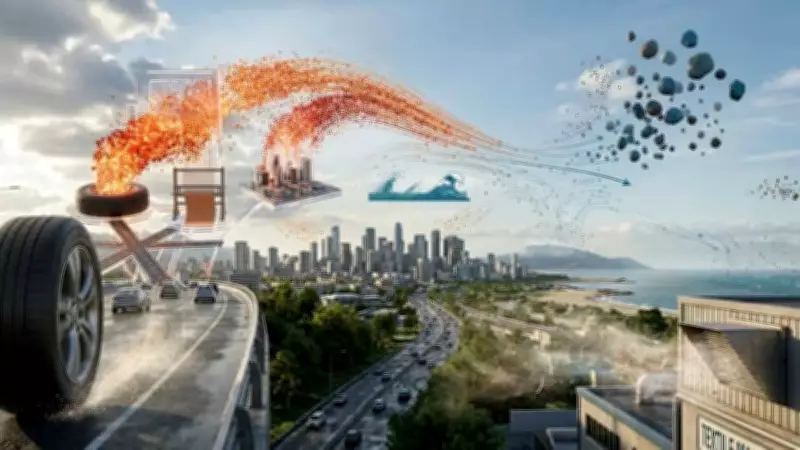
A new study by the Department of Meteorology and Geophysics at the University of Vienna has challenged many existing beliefs about where airborne microplastics originate. Previous assumptions that most microplastics come from the ocean have been refuted by research published in Nature, which indicates that land-based sources contribute far more particles to the atmosphere than ocean-based sources.
Land-Based Sources Dominate
The study compared 2,782 atmospheric data samples collected worldwide and used advanced transport models to show that land-based sources contribute approximately 20 times more microplastics to the atmosphere than the ocean. Researchers Ioanna Evangelou, Silvia Bucci, and Andreas Stohl found that land-based sources, primarily from tyre abrasion on roads and shedding of synthetic textile fibers, are now the primary contributors to atmospheric microplastics. This represents a paradigm shift in environmental science, as oceanic spray was previously considered a major source.
How New Data Refined Atmospheric Modeling
A critical component of the study involved rigorous comparison between real-world atmospheric observations and existing transport model results. The team discovered that prior models consistently overestimated microplastic particle prevalence, often by several orders of magnitude. By identifying this gap, researchers recalibrated models to account for land-ocean emission disparities, correcting long-standing errors and providing a more accurate representation of pollutant distribution.

Remaining Uncertainties
Lead author Andreas Stohl acknowledges significant uncertainties remain, particularly regarding particle size distribution. While most particles by count come from land, the total mass of emitted particles is greater over the ocean because oceanic particles tend to be larger. The team emphasizes the need for improved data collection methods and source separation techniques to better estimate emissions from individual sources like automotive versus industrial emissions, and to understand long-term environmental effects.
This research demonstrates the importance of accurate data on atmospheric particle quantities from various sources, including abrasion of transportation network surfaces, to fully understand how synthetic products move through Earth's atmosphere. The findings change our understanding of plastic pollution globally, highlighting the dominant role of human-dominated land environments.