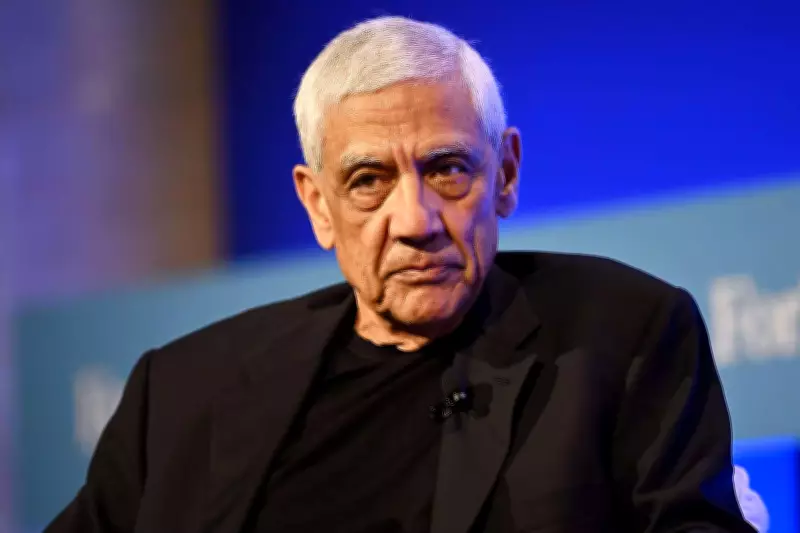
Vinod Khosla Calls for Radical US Tax Reform Amid AI-Driven Job Displacement
American venture capitalist and Sun Microsystems co-founder Vinod Khosla has ignited a crucial debate by proposing a sweeping overhaul of the United States taxation system. His call comes in response to the profound impact artificial intelligence is expected to have on the job market, potentially eliminating millions of roles and reshaping the economic landscape.
Shifting Tax Burden from Labor to Capital
In a detailed post on the social media platform X, formerly known as Twitter, Khosla argued that as AI technology advances, the labor portion of the economy will decline sharply. This shift necessitates a fundamental rethink of how governments collect revenue. He advocates for moving the tax burden away from wages and toward capital, questioning the preferential treatment currently given to capital gains taxes.
"AI will transform economies and need a rethink of capitalism & equity," Khosla wrote. "Labor portion of economy (vs capital) will decline sharply. Should we eliminate preferential treatment of capital gains tax and equalize to ordinary income? 40% of capital gains taxes are paid by those with income >$10m/year!"

Professions at High Risk from AI Automation
Accompanying his post, Khosla shared a video highlighting specific professions vulnerable to AI disruption. He identified roles such as accountants, therapists, truck drivers, and chip designers as being particularly at risk. This visual representation underscores the widespread nature of the threat, extending beyond traditional blue-collar jobs to include highly skilled white-collar positions.
Khosla has previously made bold predictions about AI's trajectory, suggesting that within 25 years, AI could perform 80% of the work in 80% of existing jobs. Such a scenario, he believes, would make universal basic income (UBI) a likely necessity to support displaced workers and maintain social stability.
Growing Tech Leader Consensus on AI Disruption
Khosla's comments add to a growing chorus of technology leaders who are warning about AI's disruptive potential. Figures like Elon Musk have speculated that in a future dominated by AI-driven resources, work could become "optional" and money "irrelevant." These visions paint a picture of a radically different economic system where human labor is no longer the primary driver of value.
However, not all voices in the tech and financial communities are aligned. Skeptics such as Michael Burry have cautioned that the current AI boom may be a speculative bubble. They warn that companies are overinvesting in chips and data centers, which could quickly become obsolete, leading to significant economic fallout.
Implications for Policy and Economic Equity
The debate sparked by Khosla touches on core issues of economic equity and the future of work. By proposing to eliminate capital gains tax preferences, he aims to address potential inequalities exacerbated by AI. With 40% of capital gains taxes paid by individuals earning over $10 million annually, this reform could redistribute tax responsibilities more fairly in an AI-dominated economy.
As governments worldwide grapple with the implications of AI, Khosla's proposal highlights the urgent need for proactive policy adjustments. The transition may require not only tax reforms but also social safety nets like UBI to mitigate the adverse effects on employment and ensure a more equitable distribution of AI-generated wealth.