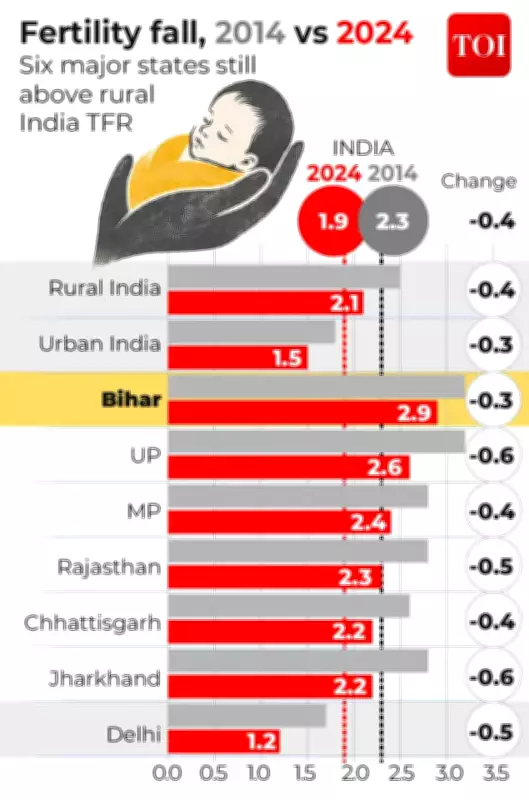
India's fertility rate has fallen below replacement level, but a closer look at the latest Sample Registration System (SRS) data reveals a country of stark contrasts. The national Total Fertility Rate (TFR) now stands at 1.9, down from 2.3 in 2014, signaling the end of the baby boom. However, this average masks wide regional variations: Bihar remains at 2.9, Uttar Pradesh at 2.6, Madhya Pradesh at 2.4, Rajasthan at 2.3, and Chhattisgarh and Jharkhand at 2.2 each. At the other end, Delhi sits at 1.2. The World Bank has warned that South Asia is not creating enough jobs for its working-age population, especially youth and women, making the concentration of above-replacement fertility in poorer states a critical policy challenge.
Urban Bihar Breaks the Pattern
Urban India's General Fertility Rate (GFR) fell from 61.2 to 51.0 births per 1,000 women aged 15-49 between 2012-14 and 2022-24. But urban Bihar saw a rise from 75.9 to 77.5, with a single-year GFR of 80.3 in 2024 against the national urban average of 49.8. This defies the assumption that urbanization automatically reduces family size.
The Thinning Birth Ladder
First-born children now account for 66.4% of live births, up from 43% in 2014. Third-and-higher-order births fell from 25.9% to 10.8%, and fourth-or-higher births dropped from 10.8% to 3.5%. This shift means families are investing more in fewer children, with implications for education and old-age security.

Infant Mortality Drops, But First Week Remains Critical
Infant mortality fell from 39 to 24 deaths per 1,000 live births between 2014 and 2024, and under-five mortality dropped from 45 to 28. However, the proportion of infant deaths occurring in the first week rose slightly from 52% to 52.7%, indicating that neonatal mortality remains a stubborn challenge.
Hospitals Oversee Birth, but Death Often Goes Unattended
Institutional births surged from 78.5% to 95.4% over the decade, with government hospitals handling 71.7% of deliveries in 2024. Yet, the share of deaths with medical attention before death fell from 42.6% to 40.2%, while deaths with no medical attention or from untrained functionaries rose from 22.4% to 45.5%. This disparity highlights a gap in end-of-life care and cause-of-death registration.
As India navigates its next phase of growth, these five data points from the SRS underscore the need for targeted policies in health, education, and employment to address the uneven demographic landscape.