India's AI Revolution Accelerates with Major Government Backing
India's artificial intelligence story has gained remarkable speed in recent years. The country is witnessing rapid infrastructure development and growing enterprise adoption. In March 2024, the Union Cabinet approved more than ₹10,300 crore specifically for the India AI Mission. This substantial funding demonstrates the government's strong commitment to building AI capabilities.
The Centre has allocated ₹21,936.90 crore to the Ministry of Electronics and Information Technology in its 2024–25 Budget. These significant financial investments create a solid foundation for India's AI ecosystem to flourish.
Enterprise Adoption Shows Strong Growth
Indian companies are embracing artificial intelligence at an accelerating pace. According to NASSCOM's 2024 AI Adoption Index, India now scores 2.47 on a four-point scale. This represents an improvement from the 2022 score of 2.45.

The data reveals that 87% of companies now fall into the "Enthusiasts" or "Experts" categories. More importantly, the number of "Expert" or scaled AI adopters has doubled during this period. This indicates that organizations are moving beyond experimentation to meaningful implementation.
India's AI talent pool continues to expand significantly. Projections suggest it will reach 1.25 million professionals by 2027. Government-backed mission frameworks are helping align priorities across different sectors.
From Assistance to Autonomous Coordination
A critical transformation is occurring within enterprises. Artificial intelligence is evolving beyond simple point solutions and copilots. Companies are now developing agentic systems capable of reasoning, planning and acting across entire workflows.
Instead of merely assisting with individual tasks, autonomous AI agents are beginning to coordinate complex processes. These systems operate across manufacturing, logistics, finance and public services. As they assume greater responsibility, questions about control, accountability and reliability become increasingly important.
These concerns directly influence how governments and enterprises approach sovereign AI. The concept refers to a nation's ability to control its AI infrastructure, data, models and governance frameworks. Sovereign AI reduces dependence on external platforms whose policies or availability might change unpredictably.
The LiveMint Sovereign AI Summit 2026
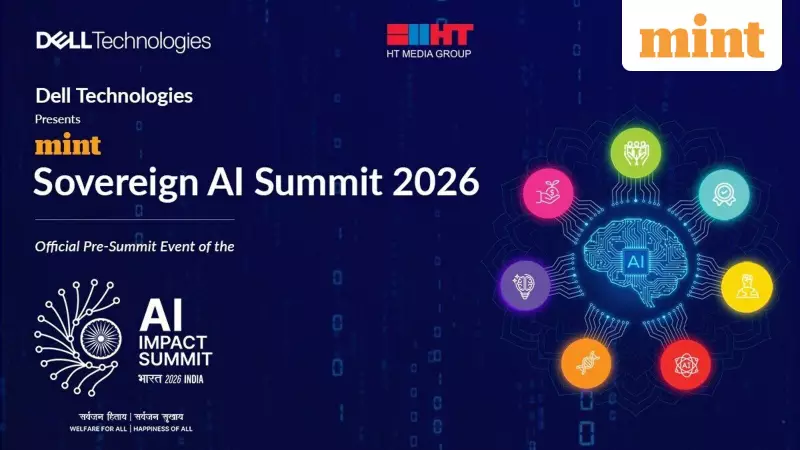
The LiveMint Sovereign AI Summit 2026, presented by Dell Technologies, will address these crucial issues. This invite-only working forum brings together policymakers, industry leaders and practitioners. Participants will examine how governance and infrastructure can keep pace with increasingly autonomous systems.
An officially affiliated pre-summit event for the India AI Impact Summit will convene in New Delhi on January 23rd. This gathering aims to extract lessons from live deployments and examine unresolved trade-offs. The discussions will generate practical inputs that can shape both policy and execution.
Manish Gupta, President and Managing Director of Dell Technologies India, has emphasized this evolution. "AI agents will evolve from assistants into coordinators of complex processes across manufacturing, logistics and public services," he noted. "These agents will optimize workflows, ensure operational continuity, and act as digital managers that elevate efficiency across entire systems."
India's Unique Position for Sovereign AI
India possesses several advantages in pursuing sovereign AI. The country has a large and diverse enterprise base with rising domestic demand. Expanding AI infrastructure combines with a proven digital public stack that operates at population scale.
Indian organizations are adapting AI systems to local languages, distinct workflows and real-world operating constraints. These adaptations are not limitations but rather forces that encourage flexibility and resilience. AI systems designed for India often prove better suited for other large, diverse economies in the Global South.

"Sovereign AI is emerging as the cornerstone of innovation," explained Manish Gupta. "It offers India a unique opportunity to build resilient and trusted AI infrastructure. As we scale AI across the nation, robust governance frameworks and controlled AI environments are becoming essential to innovate safely and sustainably."
Governance as the Operating System
Governance plays a central role in transforming potential into advantage. At scale, governance functions as the operating system that enables AI systems to move faster with confidence. Clear data stewardship, accountable deployment pathways and trusted operating environments reduce friction during implementation.
The next significant challenge involves coordination. Infrastructure, data, governance frameworks, talent pipelines and deployment incentives must align properly. Without this synchronization, India risks deepening adoption without building durable, sovereign capability.
Compute choices must align with long-term policy intent and enterprise needs. Data readiness must evolve alongside governance and trust frameworks. Talent pipelines must support not only model development but also deployment, oversight and long-term stewardship.
A Focused Platform for Practical Discussion
The LiveMint Sovereign AI Summit 2026 positions itself as a focused prelude to the India AI Impact Summit scheduled for February 19-20th. The day opens with government and industry perspectives. Manish Gupta will deliver a welcome keynote framing what sovereign AI looks like from the operating edge.
Senior government leadership involved in India's AI mission will establish the national framing. Affordable compute access, Indian-language AI systems and trusted governance frameworks represent key priorities under the India AI Mission.
The summit will feature structured working sessions designed to deepen and operationalize discussions. Plenary conversations will focus on national priorities and shared challenges in scaling AI with trust and inclusion. Fireside discussions will bring leadership perspectives on execution, partnerships and sequencing.
Masterclasses will take a practical approach, examining how organizations implement governance and how India's AI compute backbone can be built efficiently at scale. The focus remains consistent across all formats: moving AI from pilots to production, building resilient infrastructure, enabling speed without sacrificing trust, and ensuring inclusion across languages, abilities and access conditions.
From Conversation to Consequence
The LiveMint Sovereign AI Summit 2026 aims to ensure that when India's AI leaders gather again in February, conversations move faster and land sharper. Dell Technologies brings a system-level perspective informed by real-world deployment experience across industries.
India's sovereign AI moment approaches, but its shape will depend less on ambition than on alignment. Current decisions about infrastructure, governance and collaboration will determine whether AI in India remains a collection of powerful tools or matures into trusted systems that institutions can scale and other countries can learn from.