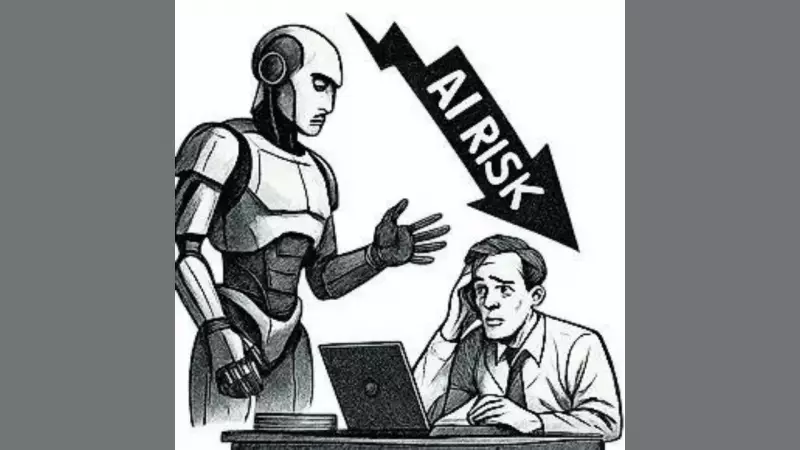
India is positioned to experience a significantly lower risk of job disruption from artificial intelligence in cognitive roles compared to advanced Western economies, according to a senior government official. The observation highlights a potential structural advantage for the country's vast workforce.
India's Workforce Composition Offers a Shield
IT Secretary S Krishnan recently articulated this perspective, pointing to the distinctive makeup of India's employment landscape. He emphasized that the country has a relatively lower proportion of white-collar roles within its overall workforce when measured against Western nations. This demographic reality, Krishnan suggested, acts as a buffer against the widespread displacement of cognitive jobs that AI is expected to trigger elsewhere.
"For India, where the number of white-collar jobs relative to other jobs is much lower than in the West, this risk to cognitive jobs, I don't think, is as serious as it is in other places," Krishnan stated. This analysis reframes the global anxiety around AI and employment through a uniquely Indian lens.

Stem Dominance as a Springboard for New Opportunities
Beyond just being a protective factor, Krishnan highlighted a proactive avenue for growth. He noted that a substantial share of India's existing white-collar employment is concentrated in the Stem (Science, Technology, Engineering, and Mathematics) space. This foundation, he argued, is not just safe but is precisely the domain where novel AI-driven opportunities will emerge.
"Also, the fact that most of our white-collar jobs are in the Stem space means we have an opportunity," he added. The real transformative impact of AI, according to him, will materialize through the development and deployment of tailored, sector-specific applications. This process is not fully automated but will demand large numbers of trained professionals to build, manage, and implement solutions.
AI as an Enhancer, Not a Sole Replacement
Krishnan distinguished the AI revolution from previous industrial shifts. He pointed out that while past revolutions primarily replaced manual labour with machinery, AI is the first technological wave posing a direct challenge to knowledge workers and cognitive labour. However, he pushed back against apocalyptic predictions of total job elimination.
"I personally don't think we'll reach that stage in such a hurry. What it (AI) would do is enhance human capability (such) that you can be much more productive in your cognitive tasks and have access to the resources," Krishnan explained. This vision positions AI as a powerful tool for augmentation, boosting productivity and access to information rather than rendering human workers obsolete.
The official's comments underscore a strategic outlook where India's workforce composition and existing strengths in technical fields could allow it to navigate the AI transition differently, potentially turning a global challenge into a source of new-age job creation and competitive advantage.